The most successful pet products are rarely the ones with the most decorative features or the thickest padding. They are the products that feel comfortable during daily use, remain secure when an animal suddenly pulls, dry properly after wet walks, and still look consistent after repeated cleaning. Neoprene can help pet brands achieve this balance because it combines a soft foam structure with a printable textile surface, but the material must be assigned the right role inside the product.
The best neoprene products for pet brands include padded dog harnesses, collars, leash handles, coordinated walking sets, dog life jackets, water jackets, feeding mats, travel mats, treat pouches, and waste-bag holders. Neoprene performs best as a flexible cushioning or protective layer combined with load-bearing webbing, reinforced stitching, secure hardware, suitable linings, and product-specific fit and performance testing.
A product may be described as using 3 mm neoprene, yet thickness alone cannot tell a buyer whether it will perform well. Foam density, stretch direction, surface fabric, lamination quality, binding, internal reinforcement, and the relationship between the padding and structural webbing all affect the finished result. Two harnesses made from nominally identical material can behave very differently after a dog runs, twists, backs away, or wears the product for an hour.
Consider a harness that looks impressive in a product photograph but rotates during movement and rubs behind the front legs. The neoprene itself may not be defective. The real problem may be the panel shape, strap position, grading system, or unsupported D-ring attachment. That is why the best neoprene pet products are developed as complete working systems rather than as attractive pieces of soft material with buckles sewn onto them.
What Makes Neoprene Good for Pet Products?
Neoprene is suitable for many pet products because it offers cushioning, flexibility, water resistance, shape recovery, and a large printable surface. It works particularly well in areas that contact the animal’s body or the owner’s hand. For load-bearing products, it should usually be combined with structural webbing, reinforced stitching, stable hardware, and suitable linings rather than carrying the full working force by itself.
Comfort and Cushioning
Neoprene is a closed-cell synthetic rubber foam that is normally laminated with polyester, nylon, jersey, or another textile surface. The foam compresses slightly under pressure and then recovers, which helps soften contact between a product and the body. This characteristic is useful around the chest, neck, belly, and other areas where narrow straps or hard edges can create uncomfortable pressure during walking, training, travel, or outdoor activity.
The cushioning benefit still depends on pattern shape and placement. A thick chest panel is not automatically more comfortable than a thinner one. If the panel is too wide, positioned too close to the front legs, or graded incorrectly between sizes, it can restrict movement and create repeated friction. A well-shaped 2.5 mm or 3 mm pad can perform better than a 5 mm pad that does not follow the animal’s body or becomes excessively warm.
In padded collars, neoprene is often placed behind structural webbing so the dog feels a softer surface while the webbing controls size and strength. The foam should remain smooth when the collar curves around the neck. If the neoprene is too thick relative to the collar width, the edges may roll, the buckle may sit awkwardly, and the collar may take longer to dry after rain or washing.
Leashes use neoprene in a different way. The greatest value is usually inside the handle, where cushioning reduces pressure on the owner’s hand during long walks or sudden pulling. Covering the entire leash in neoprene can add weight, stretch, and moisture retention without creating the same practical benefit. A structural webbing leash with a carefully padded handle generally offers better control and easier maintenance.
Water and Outdoor Use
Neoprene does not take in water like an open-cell household sponge, which makes it useful for pet products exposed to rain, wet grass, swimming, boating, beaches, and outdoor travel. Laminated surfaces can often be wiped or rinsed more easily than many natural materials, while the flexible foam remains comfortable when shaped around the body or used in a portable mat.
A finished neoprene product is not completely waterproof merely because the foam has low water absorption. Moisture can enter through needle holes, binding, cut edges, textile surfaces, seams, and spaces between laminated layers. After wet use, the product still needs airflow and sufficient drying time. Packing a damp harness, collar, or jacket inside a sealed bag can create odor and may eventually affect surface cleanliness or lamination.
For dog water jackets, neoprene can provide warmth, flexibility, body contact, and a smooth protective surface. For life jackets, however, the flotation function must come from a properly designed buoyancy system. Neoprene should not be assumed to provide enough buoyancy on its own. The finished product needs appropriate flotation material, secure straps, correct body coverage, a reinforced lifting handle, visibility, and enough freedom for natural swimming movement.
Climate also matters. Broad neoprene panels may feel warm in hot weather, especially on dark-colored products or thick-coated animals. Designers can reduce this risk with narrower contact zones, lighter material, ventilation openings, or selected mesh sections. The goal is not to remove padding entirely, but to place it only where it provides a meaningful benefit.
Branding and Appearance
Neoprene gives pet brands a larger visual surface than narrow webbing alone. Polyester-faced neoprene can support all-over patterns, illustrations, seasonal graphics, gradients, repeated motifs, and coordinated color systems. This allows a harness, collar, pouch, and mat to look like part of one recognizable collection instead of unrelated products carrying the same small label.
Sublimation printing is commonly used on light-colored polyester surfaces because the artwork becomes part of the textile rather than forming a thick layer above it. The printed area remains flexible, although final color depends on the base fabric, artwork profile, heat settings, material batch, and laminated foam underneath. Physical color approval is more reliable than evaluating artwork only on a computer screen.
Other branding methods include heat transfer, screen printing, woven labels, rubber patches, silicone badges, embroidery, custom webbing, and molded hardware. Each method affects flexibility, surface feel, durability, cost, and order quantity. A large rubber patch may look premium on a medium harness but create too much stiffness on a small collar, while dense embroidery may compress the foam and distort the surrounding panel.
Branding should therefore be tested on the finished shape rather than only on a flat swatch. A logo positioned close to a curved seam may appear distorted after assembly. A heat-transfer graphic may stretch differently once the harness is adjusted around the body. A print repeat may look balanced on a large panel but appear randomly cropped on the smallest size.
Practical Limitations
Neoprene is not suitable for every component or every use condition. It can hold heat, retain moisture around stitched areas, develop odor if stored wet, crease after long compression, and suffer damage from persistent chewing. Exposed foam edges are particularly vulnerable when they are used as unsupported tabs or attachment points, so binding and reinforcement should be planned before the pattern is approved.
The material is also not normally the primary load-bearing element in a harness, collar, or leash. Structural force should travel through webbing, reinforced fabric layers, suitable hardware, and controlled stitching. The neoprene adds comfort, shape, protection, and visual value around this structure. Treating it as both the soft padding and the only structural element can result in excessive stretching or tearing around the attachment areas.
Thickness must be selected according to product function rather than appearance. Material around 1.5–2 mm is flexible and useful for small accessories, collar padding, and folded components. Material around 2.5–3 mm often provides a practical balance between cushioning and sewability. Thicker options may suit protective panels, water jackets, or mats, but they also create bulk at seams and require wider binding and revised sewing settings.
| Neoprene Range | Typical Characteristics | Common Pet Applications | Main Development Concern |
|---|---|---|---|
| 1.5–2 mm | Lightweight, flexible, easy to fold | Collar padding, leash handles, small pouches | Limited cushioning and protection |
| 2.5–3 mm | Balanced padding and flexibility | Harnesses, collars, mats, walking accessories | Density and seam construction still matter |
| 4–5 mm | Higher cushioning and insulation | Water jackets, protective panels, thicker mats | Bulky seams, greater warmth, slower drying |
| Over 5 mm | High bulk with limited flexibility | Specialized protection or support products | Difficult grading, sewing, and body movement |
The most reliable design approach is to use neoprene where it solves a clear problem, such as cushioning a contact point, improving hand comfort, providing a printable surface, protecting an item, or supporting wet-environment use. Using the material only because it appears premium can create unnecessary weight, warmth, drying time, and production complexity.
Which Neoprene Pet Products Work Best?
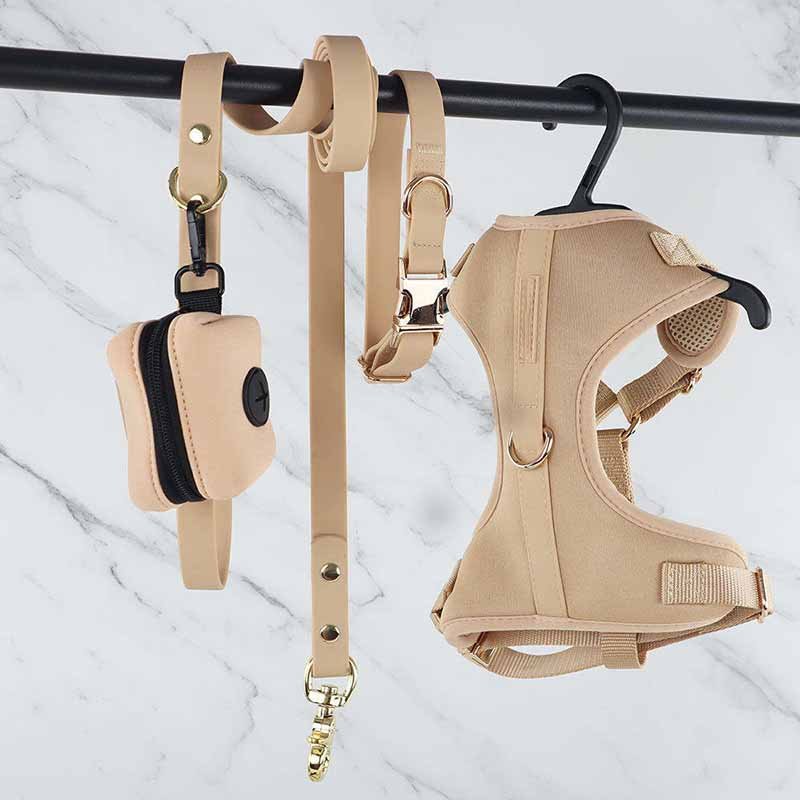
The strongest neoprene product opportunities include padded harnesses, collars, leash handles, walking sets, dog life jackets, water jackets, feeding mats, travel mats, treat pouches, and waste-bag holders. Harnesses normally provide the clearest combination of comfort, function, and visible branding, while matching accessories help brands increase collection value without developing an entirely separate material system for every product.
Harnesses and Walking Sets
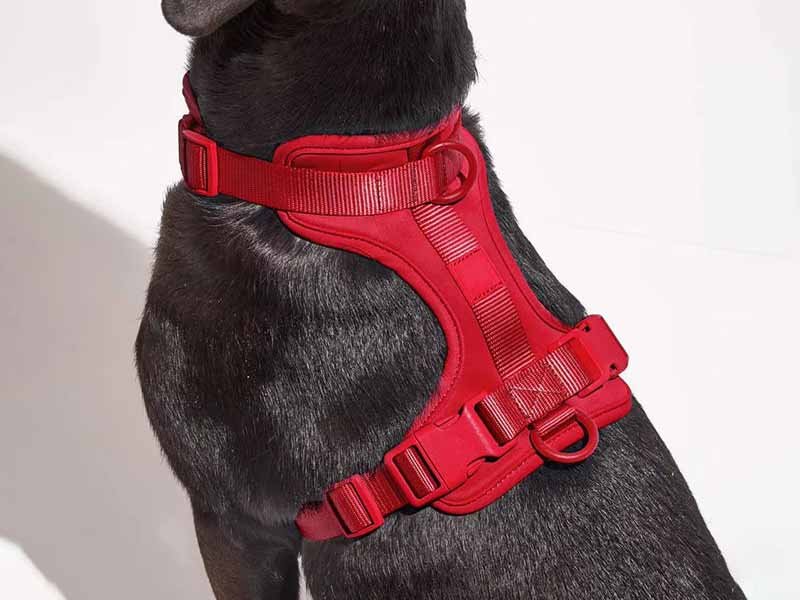
Harnesses are among the strongest neoprene applications because the material can create broad body contact, visible branding, and localized padding while webbing manages the primary pulling force. The design may be developed as a step-in harness, vest harness, overhead harness, no-pull harness, or outdoor harness, depending on the intended user, dog size range, climate, and retail positioning.
A step-in harness can be convenient for dogs that dislike products passing over the head. A vest-style harness offers a larger printed area and can distribute contact across a wider section of the chest. A no-pull model may include a front attachment point, but its geometry requires careful testing. If the front ring is positioned too low or the straps are too loose, the harness may twist instead of helping the owner maintain control.
A harness should not be developed in isolation from its size system. The smallest and largest sizes may require different panel proportions, webbing widths, and hardware weights. Enlarging every pattern measurement by the same percentage can create excessive chest coverage on large dogs and insufficient leg clearance on small dogs. Physical fitting of multiple sizes is therefore important before a full collection enters production.
The strongest retail opportunity often comes from creating a coordinated walking system. A matching harness, collar, leash, and waste-bag holder can share the same print, webbing color, hardware finish, label style, and packaging language. This allows the brand to sell products individually or as bundles while maintaining a clear and recognizable identity.
Collars and Leashes
Neoprene-padded collars are relatively straightforward products, but the relationship between foam thickness, webbing width, buckle size, and adjustment range must be carefully controlled. The neoprene should cover or soften the webbing edges without making the collar so bulky that it curves poorly or creates a large stiff overlap near the buckle.
Small collar sizes often need thinner padding and lighter hardware. Large sizes may require wider webbing, heavier D-rings, and stronger reinforcement. Using the same buckle and foam thickness across every size may simplify purchasing, but it can make the smallest product uncomfortable and the largest product under-engineered.
The adjustment system should also be tested throughout its full range. A collar may technically adjust from one measurement to another while still fitting poorly because the buckle, slider, padded area, and D-ring overlap in inconvenient positions. The finished collar should remain smooth and balanced when adjusted near both its minimum and maximum sizes.
Leashes normally gain the greatest benefit from a neoprene-padded handle. The main leash body can remain structural webbing, rope, or coated material, while the handle provides hand comfort. Brands may also consider traffic handles, reflective details, accessory D-rings, swivel hooks, double-ended clips, or reinforced handle joints, but every added feature should solve a real use problem rather than simply increasing the number of components.
Water and Travel Products
Dog life jackets, swimming vests, water jackets, and protective wet-environment apparel are natural areas for neoprene because the material remains flexible, follows body contours, and can provide warmth and surface protection. These products require more development control than a collar or mat because poor fit can restrict movement, while weak lifting points or unstable closures can create significant safety risks.
A life jacket must use properly selected flotation materials and should be evaluated as a complete buoyancy system. The position of the flotation panels influences how the dog sits in the water. Belly straps, chest support, neck areas, and adjustment points must remain stable when wet. A lifting handle should connect to internal webbing or reinforced structural panels rather than being sewn only onto the outer neoprene.
Water jackets without flotation have a different function. They may provide warmth, abrasion protection, or a close-fitting layer for cold conditions. Product descriptions and packaging should clearly distinguish between thermal apparel and flotation equipment. Confusing the two may create unrealistic customer expectations and unnecessary safety exposure for the brand.
Travel mats, feeding mats, bowl mats, crate pads, and portable resting surfaces are lower-risk neoprene products that can extend the same visual collection into home, car, camping, and hotel use. Their quality depends on flatness, surface durability, lamination, binding, cleaning performance, and resistance to curling after packaging.
Small Accessories
Small neoprene accessories can improve collection economics because they require less material, involve fewer size variations, and can be sold as add-ons or included in bundles. Common options include treat pouches, waste-bag holders, tracking-device holders, collar sleeves, bottle holders, protective wraps, and compact travel organizers.
A treat pouch should be easy to open with one hand and should not absorb strong food odors. Using a washable lining or removable inner section may be more practical than allowing food to contact the neoprene surface directly. The opening must balance fast access with sufficient closure security when the owner walks, runs, or bends down.
A waste-bag holder should allow smooth dispensing without tearing the roll or creating an oversized opening. The attachment point should resist twisting and should not interfere with the leash handle. Small tracking-device holders require precise dimensions and stable retention so the device remains secure during running while still being removable by the owner.
| Product | Main Neoprene Function | Size Complexity | Development Risk | Collection Potential |
|---|---|---|---|---|
| Padded harness | Body comfort and printed surface | High | High | Very high |
| Padded collar | Neck cushioning | Medium | Medium | High |
| Leash handle | Owner hand comfort | Low | Low | High |
| Dog life jacket | Flexible body construction | High | Very high | High |
| Feeding mat | Water-resistant printed surface | Low | Low | Medium |
| Travel mat | Cushioning and protection | Low | Low to medium | Medium |
| Treat pouch | Soft structured body | Low | Medium | High |
| Waste-bag holder | Coordinated small accessory | Low | Low | High |
For many brands, the most manageable opening range is one well-tested harness, two or three coordinated color options, a matching collar, a leash, and one small accessory. This creates enough variety for merchandising and bundle sales without producing an excessive number of size, color, hardware, and packaging combinations before demand has been validated.
How Should Brands Choose Materials and Construction?
Brands should select neoprene materials according to product function, animal size, climate, cleaning requirements, and structural load. Thickness alone is not a complete specification. Density, stretch, surface lamination, lining, webbing, binding, hardware, reinforcement, branding, and size grading must work together. In load-bearing products, soft neoprene components should be supported by a separate structure that manages pulling, lifting, and repeated adjustment.
Thickness and Density
Two neoprene sheets with the same nominal thickness can behave very differently because density, compression resistance, stretch, recovery, surface fabric, and lamination quality all affect performance. A soft 3 mm foam may feel comfortable during the first inspection but compress excessively under a buckle or stitch line, while a firmer 3 mm material may retain shape better but feel less flexible on a small dog.
Physical swatches are therefore more useful than written thickness numbers alone. Buyers and developers should compare how the material compresses under finger pressure, how quickly it recovers, how it behaves when bent repeatedly, and whether the laminated surface creases or separates. Material weight and stretch direction should also be reviewed because they affect panel stability and fit.
Thickness changes sewing requirements. A 4 mm panel may become 8 mm or 12 mm thick where multiple layers overlap. Standard binding may no longer cover the edge, and ordinary sewing settings may create skipped stitches, compressed foam, or uneven feeding. The pattern should therefore be developed around the finished layer structure rather than around a single flat material measurement.
Density is often missing from basic quotations, so the approved material sample should become the practical reference standard. Production rolls should be compared with that sample for feel, thickness, recovery, surface condition, color, and lamination before bulk cutting begins.
Surface and Lining
Most pet products use fabric-laminated neoprene rather than exposed rubber foam. The outer textile affects appearance, print quality, abrasion resistance, hair collection, hand feel, drying behavior, and color consistency. Polyester-faced neoprene is widely used for sublimation printing, while nylon-faced material may offer a different surface texture and abrasion profile.
The inner surface should be selected according to body contact and climate. Soft jersey can improve skin comfort but may attract hair or dirt depending on its knit. Spacer mesh can add airflow and create a lighter contact feel, although it increases thickness and changes sewing behavior. A smooth inner textile may be easier to wipe but could feel warmer against the body.
Some products use the same laminated surface on both sides to simplify sourcing and production. Others use a printed exterior and a different lining on the inside. A mixed construction may improve comfort or ventilation, but it also increases material purchasing, cutting, identification, and inspection requirements.
Lamination adhesion is particularly important around curved seams, tight folds, binding, and repeated flex points. Poorly bonded surfaces may begin peeling near needle holes or along edges after wet use. The material should therefore be bent, stitched, and handled during sampling rather than being approved only as an untouched flat swatch.
Webbing and Hardware
Load-bearing products require webbing and hardware that match the animal size, product purpose, and intended force. A buckle suitable for a lightweight small-dog accessory should not automatically be used in a large outdoor harness simply because the color and shape match the collection.
Webbing width often ranges from approximately 10–15 mm in very small accessories to 20–25 mm in many everyday collars and harnesses. Larger or more demanding products may use 30–38 mm webbing. These measurements are general development references, not universal safety ratings, because weave, thickness, fiber, stitching, and component quality also affect performance.
The webbing must fit the buckle and slider correctly. Material that is too thin may slip through the adjustment hardware, while excessively thick webbing may prevent smooth buckle operation or make adjustment difficult. Edges should remain smooth enough to avoid cutting into the neoprene, lining, or the animal’s body.
Hardware evaluation should cover buckle engagement, opening force, slider retention, D-ring deformation, leash-hook closure, corrosion resistance, sharp edges, surface finish, component weight, and noise during movement. A large metal hook may make a small leash unbalanced, while a lightweight plastic hook may not be appropriate for demanding outdoor use.
Reinforcement and Branding
Reinforcement should follow the direction of force. High-stress areas commonly include D-ring attachments, lifting handles, leash handles, buckle returns, and adjustment points. Depending on the design, reinforcement may involve bartacks, box stitches, crossed box stitches, folded webbing returns, backing layers, or internal support patches.
Adding more stitch lines does not automatically create a stronger product. Dense stitching placed too close together can perforate a narrow webbing return or weaken laminated material. Reinforcement needs enough sewing area, correct thread tension, and appropriate alignment with the load path.
Branding must also fit the product structure. Sublimation printing works well for full-pattern graphics on suitable polyester surfaces. Heat transfers can provide detailed logos but require stretch and washing checks. Rubber and silicone patches create a strong three-dimensional appearance but add stiffness and weight, especially on small products.
| Component | Common Specification Range | Main Selection Priority | Frequent Development Mistake |
|---|---|---|---|
| Neoprene body | 2–5 mm | Comfort, flexibility, layer thickness | Selecting material by thickness only |
| Structural webbing | 15–38 mm | Load path and hardware compatibility | Using one width for every product size |
| Binding tape | 15–30 mm folded width | Edge coverage and softness | Binding too narrow for layered seams |
| Plastic buckle | Matched to webbing size | Engagement, cycling, release force | Choosing mainly by appearance |
| Metal D-ring | Product-specific wire gauge | Deformation resistance | Sewing it only to unsupported foam |
| Logo patch | Based on usable panel area | Flexibility and visibility | Oversizing patches on small products |
Size and color planning should begin during material selection rather than after the sample is approved. Five sizes offered in four colors already create 20 SKUs before packaging or regional labeling differences are added. Brands should verify that the expected quantity per combination is realistic for material purchasing, production setup, inspection, inventory, and future replenishment.
What Safety and Quality Checks Matter
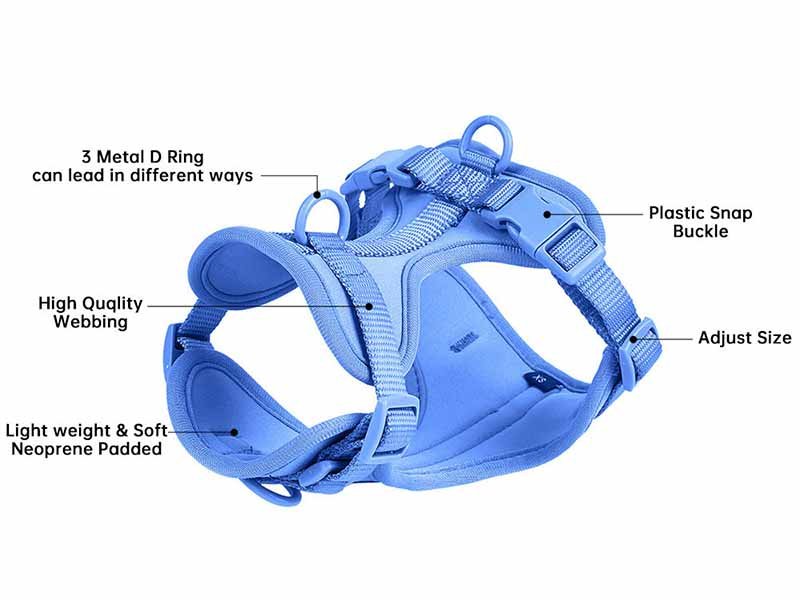
Critical safety and quality checks include fit, movement, adjustment security, pulling resistance, buckle operation, seam strength, edge comfort, odor, colorfastness, lamination, dimensions, cleanliness, packaging, and labeling. Pet products should be evaluated under realistic conditions rather than approved only by appearance. The final approved sample should become a measurable reference for materials, construction, function, dimensions, and visual quality throughout bulk production.
Fit and Movement
Fit problems are common because dogs with similar chest measurements can have very different neck widths, shoulder angles, chest depths, coat thicknesses, and body proportions. A harness that fits one breed comfortably may rotate, rub, or allow escape on another dog within the same general weight category.
Testing should involve movement rather than a standing photograph. The dog should walk, turn, sit, lie down, climb steps, move backward, and pull gently in several directions. The tester should watch for shoulder restriction, throat pressure, armpit rubbing, unstable D-rings, rotating panels, loose openings, and buckles pressing against the body.
Armpit clearance deserves particular attention because a chest panel or side strap positioned too close to the front leg can rub during every step. Increasing the overall size may not solve the problem if the pattern geometry is wrong. The panel shape, strap route, and attachment position may need revision instead.
Adjustment should remain accessible while the product is worn, and sliders should not sit directly under high-pressure body areas. Fit records should include the animal’s measurements, product size, adjustment position, photographs, observed movement issues, and required pattern changes. These records turn subjective feedback into measurable development actions.
Pull and Hardware Tests
A finished product is only as strong as its weakest assembled point. High webbing strength does not prove that a harness or leash is reliable because failure may occur at the D-ring attachment, buckle, slider, folded return, hook gate, handle seam, or transition between the rigid component and the soft neoprene panel.
Testing should match the intended product and animal size. There is no single universal pull value suitable for every collar, harness, leash, or life jacket. A lightweight accessory designed for a small dog requires different components and test conditions from a large outdoor harness.
Useful internal evaluations include static pulling, repeated loading, buckle cycling, slider slippage checks, hook operation, D-ring deformation checks, inspection of needle holes after loading, and wet-condition evaluation for water products. Products with lifting handles should also be checked to confirm that the force travels through internal structural reinforcement.
Brands should avoid unsupported performance claims based only on the rating of one buckle, ring, or webbing roll. A component may perform well in isolation while the finished sewn assembly fails at a much lower force. Marketing claims should reflect finished-product testing and the intended use conditions rather than the strongest individual component.
Material and Color Control
Incoming neoprene rolls should be compared with the approved sample before cutting. Thickness, surface appearance, shade, lamination, odor, stretch, recovery, print direction, and visible roll defects all affect production consistency. Measurements should be taken at several positions because foam thickness may vary across a roll or between batches.
Printed materials require physical approval. Important checks include color reference, pattern repeat, sharpness, orientation, surface marks, heat discoloration, rubbing resistance, water exposure, and lot-to-lot consistency. A color displayed accurately on a design monitor may appear different after printing onto laminated material.
Odor should be evaluated before sealed packaging. New neoprene and lamination materials can have a noticeable smell, but unusually strong or persistent odor may require ventilation, investigation, replacement, or additional chemical testing. Fragrance should not be used to hide an unresolved material issue.
Color should also be checked under more than one lighting condition. Dark solid colors may reveal dust, rubbing marks, and foam particles more easily than patterned surfaces. Printed collections may hide minor marks, but they still require consistent artwork orientation and color balance across sizes and product types.
Sewing and Final Inspection
Neoprene stretches and compresses during sewing, so uncontrolled feeding can create wavy seams, twisted panels, inaccurate dimensions, uneven binding, and misaligned webbing. The first completed production units should be inspected before full line output continues. Early correction is significantly easier than repairing hundreds or thousands of completed products.
Inspection should focus on stitch spacing, thread tension, binding coverage, webbing alignment, label position, buckle direction, D-ring attachment, pattern placement, and finished measurements. High-stress reinforcement should be checked from both the front and reverse sides because an acceptable outer appearance can hide poor thread tension or incomplete penetration underneath.
| Inspection Stage | Main Checks | Examples of Rejectable Issues |
|---|---|---|
| Incoming materials | Thickness, shade, odor, stretch, lamination | Peeling, strong odor, incorrect shade |
| Cutting | Pattern orientation, dimensions, surface condition | Reversed prints, distorted or damaged panels |
| First production units | Assembly, measurements, logo, hardware | Wrong buckle direction or poor alignment |
| In-line inspection | Stitching, binding, reinforcement | Skipped stitches, loose bartacks, exposed foam |
| Final inspection | Dimensions, appearance, operation | Size variation, sharp edges, unstable adjustment |
| Packaging inspection | Size labels, barcodes, quantity, cartons | Mixed sizes, wrong barcode, compressed products |
Multi-size orders need strict separation because similar-looking harnesses or collars can easily be mixed during production and packing. Color-coded work tickets, divided bins, repeated size-label checks, and carton verification can reduce this risk. Packaging should also protect the product without compressing thick neoprene panels so tightly that they develop lasting creases.
How Do You Develop a Custom Product Line?
A custom neoprene pet collection should be developed through a controlled sequence: define the customer and use case, prepare a detailed brief, approve materials and components, develop patterns, produce prototypes, conduct fit and performance tests, revise the sample, approve measurable standards, plan quantities by SKU, and manage bulk production. The goal is to create a product system that can be reproduced consistently, not merely one attractive prototype.
Product Brief
A clear product brief prevents long correction cycles after sampling begins. It should explain what the product is expected to do, which animals will use it, where it will be sold, how it should look, what materials are preferred, and what commercial limitations must be respected.
Useful project information includes:
- Product category and reference images
- Intended dog size or weight groups
- Main use scenario and climate
- Target customer and retail positioning
- Finished dimensions and adjustment ranges
- Preferred neoprene thickness and surface
- Lining, webbing, binding, and hardware
- Logo artwork and Pantone references
- Required colors and quantities by size
- Packaging, barcode, and labeling requirements
- Destination market and required testing
- Target launch and delivery dates
The use scenario directly affects construction. A lightweight fashion harness for short city walks does not require the same material, reinforcement, and hardware as an outdoor harness intended for longer hikes. A thermal water jacket is not the same as a flotation product, even when both use similar neoprene surfaces.
Target retail positioning is also useful because it helps align the materials, hardware, branding, and packaging with a realistic commercial level. The purpose is not to reduce quality blindly, but to avoid building an unnecessarily expensive product that the intended market will not support.
Sampling and Testing
The first sample is a development tool rather than a final promise. It allows the team to review pattern shape, dimensions, material feel, color, artwork, hardware, binding, fit, sewing, adjustment, packaging, and production feasibility before committing to bulk manufacturing.
A practical development sequence includes:
- Requirement and reference review
- Material and component selection
- Pattern development
- First prototype production
- Internal construction review
- Fit and use testing
- Buyer evaluation
- Pattern and material revisions
- Final approval sample
- Bulk specification confirmation
Complex harnesses, water jackets, and multi-size products may need more than one revision, particularly when they are created from early concepts rather than complete technical files. This does not necessarily indicate poor development. It often reflects the work required to convert a visual idea into a stable fit and manufacturable structure.
Feedback should be measurable. A comment such as “increase the chest clearance by approximately 20 mm” gives the pattern team a usable instruction, while “the fit feels strange” does not identify the real issue. Photographs, body measurements, adjustment settings, and marked sample images make revision work more accurate.
The final approval should be supported by measurements, component references, material codes, artwork files, color standards, stitch requirements, packaging instructions, and approved photographs. These records help protect consistency between the sample, first bulk order, and future repeat production.
Cost and SKU Planning
Custom neoprene product pricing depends on material thickness, density, lamination, printing, cutting yield, binding, webbing, hardware, stitching time, reinforcement, testing, packaging, and the number of combinations being produced. A relatively small product can still be expensive when it contains many custom components or must be divided across numerous sizes and colors.
A harness offered in five sizes and four colors creates 20 separate SKUs. An order of 2,000 units may appear substantial, yet it averages only 100 units per combination. That division affects material ordering, cutting setup, line changes, hardware preparation, inspection, packaging, replacement stock, and future replenishment.
Brands can control complexity by launching with fewer colors, sharing hardware finishes across the range, using the same webbing shade for several prints, limiting custom-dyed components, and expanding only after real sales data is available. Matching accessories can reuse approved materials, labels, and packaging language, which often reduces development effort.
Packaging should be evaluated as part of total product cost. Retail boxes, printed cards, molded inserts, barcodes, multilingual labels, and size stickers all add design, printing, assembly, and shipping volume. Premium packaging can support brand positioning, but it should not create excessive freight cost or compress the neoprene product during storage.
Supplier and Scale-Up
A suitable manufacturing partner should understand both neoprene construction and the functional demands of pet products. Sewing capability alone is not enough. The team should be able to discuss foam behavior, lamination, pattern grading, fit, binding, webbing load paths, hardware compatibility, artwork behavior, inspection, packaging, and repeat-order control.
Supplier evaluation can include the following questions:
- Can the team develop patterns from reference samples or technical files?
- Who reviews product fit and construction?
- How is material thickness checked before cutting?
- How are webbing and hardware specifications controlled?
- Can the team support measurable sample revisions?
- How are artwork and physical colors approved?
- What inspections take place during production?
- How are sizes and colors separated?
- Can barcode and retail packaging be handled?
- How are repeat orders matched to previous batches?
Scale-up should begin with a pre-production review covering materials, components, measurements, artwork, sewing details, packaging, testing, and delivery requirements. For complex products, the first completed production units should be inspected and function-tested before the remaining quantity proceeds at full speed.
Szoneier is a Shenzhen-based custom bags and soft-goods OEM/ODM manufacturer with more than 18 years of manufacturing experience. Its project capabilities include material selection, pattern and sample development, sewing production coordination, quality inspection, packaging, and export delivery. MOQ starts from 200 pieces for selected custom projects, subject to material, structure, color, branding, packaging, and testing requirements.
After launch, customer feedback should be grouped by issue type rather than treated as isolated comments. Repeated observations about fit, buckle operation, odor, sizing, print wear, packaging damage, or adjustment should guide the next production version. A stable product range grows by improving proven products before adding unnecessary new combinations.
Build Your Neoprene Pet Product Line With Szoneier
The best neoprene pet products are not selected only by appearance or material thickness. They are developed by matching the material to a clear function, separating comfort layers from load-bearing structures, testing products during realistic movement, and controlling the details customers notice after weeks of use rather than only during the first unboxing.
Harnesses, padded collars, leash handles, water products, mats, and small accessories offer strong commercial possibilities because they combine practical performance with visible brand identity. Each product still requires its own development decisions. A harness must manage fit and pulling force, a life jacket must address buoyancy and movement, and a mat must remain flat, washable, and dimensionally stable.
Szoneier supports custom neoprene and sewn soft-goods projects from initial concept review and material selection through pattern development, sampling, revision, bulk production, quality inspection, packaging, and international shipment coordination. Buyers can begin with a reference product, technical drawing, physical sample, tech pack, artwork file, or early product idea.
To receive a project review, provide the product category, intended pet size range, material preferences, artwork, required colors, quantity by SKU, packaging expectations, destination market, testing requirements, and planned launch date. A detailed brief allows the development team to evaluate material thickness, structural webbing, hardware, sizing, printing, production feasibility, cost factors, and realistic delivery planning before sampling begins.
A well-developed neoprene pet collection should feel comfortable, perform reliably, carry a consistent visual identity, and remain practical to reproduce across future orders. The strongest product programs are built from tested materials, measurable specifications, controlled manufacturing, and improvements based on real market feedback.