
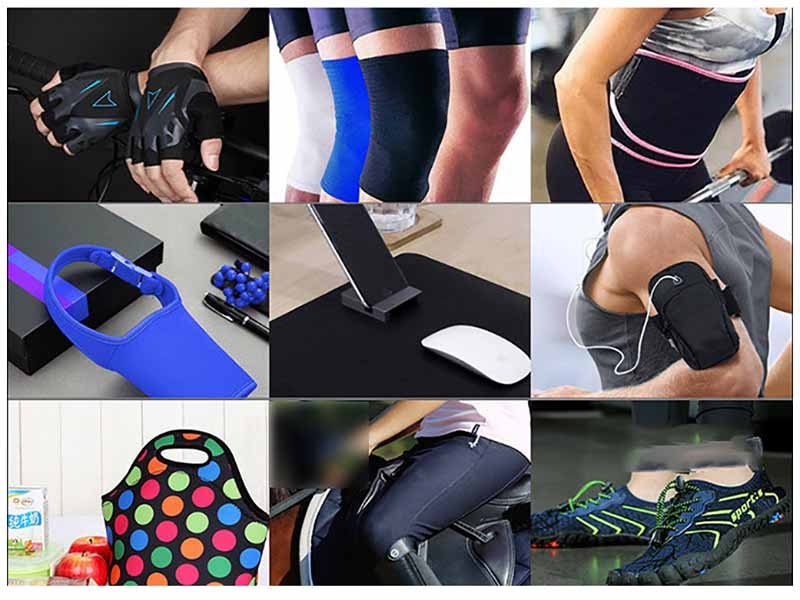
Neoprene is one of those materials you don’t notice—until you use a product made with it and realize it solves problems that “normal fabric” can’t. A gym bag that doesn’t stink after sweaty clothes. A drink holder that keeps a can cold longer than a basic foam sleeve. A knee brace that feels supportive without cutting off circulation. A wetsuit that keeps warmth even when water is cold. These are not marketing tricks; they come from how neoprene is built.
Neoprene products are items made from neoprene foam laminated with fabric (or coated surfaces) to create a soft, flexible material that resists water, cushions impact, and traps heat. They are commonly used in bags, koozies, sports supports, medical braces, wetsuits, gloves, and protective accessories, especially when customers want comfort + durability + insulation in one product.
If you’ve ever had a customer complain that a “water-resistant” bag still felt damp inside, or that a brace lost shape after a few weeks, you already understand why neoprene matters. The real value is not “neoprene” as a word—it’s choosing the right thickness, density, surface fabric, and construction so the product performs the way your customers expect.
What Is Neoprene Material?
Neoprene is a synthetic rubber foam engineered to provide stretch, cushioning, insulation, and resistance to water and weather.
Unlike woven textiles that rely only on fiber strength, neoprene combines a closed-cell foam core with laminated surface fabrics such as nylon, polyester, or spandex.
This layered structure allows one material to solve several common product problems at once:
- protecting fragile items from impact
- keeping warmth in cold or wet environments
- staying soft and comfortable against skin
- maintaining shape after repeated bending or compression
Because of this balance, neoprene is widely used in bags, drink sleeves, sports braces, medical supports, wetsuits, gloves, and protective covers.
For product developers, the real value of neoprene is not just the material itself, but how precisely it can be tuned through thickness, density, and lamination to match a specific use scenario and price level.
What makes neoprene different from regular fabric?
The biggest difference is structural.
Regular fabrics like polyester or canvas are woven fibers with air gaps between yarns, while neoprene is a foam filled with sealed microscopic cells.
These closed cells trap air and prevent fast water penetration, which explains why neoprene behaves very differently in daily use.
Key functional differences customers notice immediately:
Soft protection without extra padding
A 3 mm neoprene sleeve can absorb shocks that thin fabric cannot handle unless foam inserts are added.
Water resistance with fast drying
Closed cells limit absorption, so neoprene feels lighter after exposure to rain or sweat.
Stable comfort against skin
Laminated stretch fabric allows movement without the rough friction common in stiff textiles.
Shape recovery after compression
Quality neoprene rebounds instead of staying flattened, which keeps products looking new longer.
These differences directly affect customer satisfaction and return rates.
For example, laptop sleeves made from thin polyester often fail drop-protection expectations, while neoprene sleeves of similar thickness typically pass everyday impact tests.
Which properties define neoprene performance?
When brands compare neoprene materials, performance is controlled by a few measurable parameters.
Understanding these numbers helps avoid costly sampling mistakes.
Core physical specifications
| Property | Common Range | What It Affects in Real Use |
|---|---|---|
| Thickness | 1–10 mm | cushioning, warmth, stiffness |
| Density | 150–300 kg/m³ | durability, rebound strength, weight |
| Elongation | 150–300% | comfort during movement |
| Water absorption | usually < 5% | drying speed, odor risk |
| Temperature tolerance | about −20 °C to 120 °C | outdoor and marine stability |
How customers interpret these specs :
- Thicker → feels warmer and more protective, but heavier
- Higher density → feels more premium and lasts longer
- Higher stretch → more comfortable for body-fit products
- Lower absorption → less smell after sweat or water exposure
Because these factors interact, choosing neoprene is always a balance between comfort, durability, and cost, not a single number decision.
How does neoprene structure affect durability and comfort?
Durability in neoprene products depends on three layers working together, not just foam quality.
1. Foam cell quality
Uniform closed cells create:
- consistent cushioning
- stable insulation
- lower long-term deformation
Poor foam structure leads to:
- faster collapse under pressure
- higher water uptake
- increased odor after repeated use
2. Lamination strength
The bond between foam and fabric is one of the most common hidden failure points.
If lamination is weak, products may show:
- bubbling after heat exposure
- peeling surfaces near folds
- separation along seams
Reliable manufacturers control:
- adhesive formulation
- curing temperature and time
- pressure uniformity during lamination
3. Construction and seam design
Even high-quality neoprene fails if construction is incorrect.
Examples:
- thin thread on thick foam → seam tearing
- no edge reinforcement → curling or fraying appearance
- wrong stitch type in wetsuits → heat loss in cold water
Because of these factors, professional product development always evaluates material + lamination + construction as a system, rather than judging neoprene by thickness alone.
What Types of Neoprene Products Exist?
Neoprene products cover several major categories because the material can be tuned through thickness, density, stretch ratio, and surface lamination. This flexibility allows the same base neoprene foam to serve daily lifestyle items, protective supports, and professional water-sports gear.
For brands planning a product range, understanding these categories helps answer three critical questions early:
- Which product type matches target customers
- Which technical specifications control performance and cost
- Which construction methods reduce complaints after sale
In real manufacturing practice, neoprene products are usually grouped into four families: bags, accessories, protective gear, and apparel. Each family uses different thickness ranges, seam methods, and reinforcement structures.
Which neoprene bags are available?
Neoprene bags are among the most commercially successful neoprene products because they combine soft touch, built-in cushioning, and light water resistance without requiring complex internal padding.
Unlike polyester or canvas bags that rely on added foam inserts, neoprene bags gain structure directly from the foam core, which simplifies construction and improves long-term comfort when carried against the body.
| Bag Style | Typical Thickness | Structural Focus | Main Use Scenario |
|---|---|---|---|
| Laptop sleeve | 2–4 mm | shock absorption + slim profile | office, school, travel |
| Tote bag | 3–5 mm | soft body + moderate load support | shopping, daily carry |
| Cosmetic pouch | 2–3 mm | lightweight + easy cleaning | beauty & personal care |
| Gym duffel | 3–6 mm | sweat resistance + reinforced base | fitness & sports |
| Bottle carrier | 3–5 mm | insulation + grip stability | outdoor & commuting |
Key production concerns brands often overlook
Odor retention Sweat-exposed bags require breathable lining or antimicrobial treatment. Without this, customer complaints appear within weeks of use.
Base deformation Soft neoprene alone cannot hold heavy weight. Structured bottom panels or density upgrades are required for duffels.
Hardware corrosion Moisture-rich environments demand coated zippers or stainless components. Standard metal hardware can rust quickly in gym or coastal use.
Because of these factors, successful neoprene bag programs are rarely defined by style alone—they depend on correct internal specification planning before sampling begins.
What neoprene accessories are common?
Neoprene accessories focus on compact size, thermal function, and surface protection. Although small, these items often generate high order volume and repeat sales, making them strategically important for promotional brands and e-commerce sellers.
High-demand neoprene accessory products
| Product | Thickness Range | Functional Advantage | Sales Characteristic |
|---|---|---|---|
| Can koozie | 3–5 mm | strong insulation + flexible fit | high-volume promotional |
| Bottle sleeve | 3–5 mm | condensation control + grip | lifestyle retail |
| Phone/tablet sleeve | 2–3 mm | scratch prevention + cushioning | electronics accessory |
| Cable organizer | 2–3 mm | stretch storage + soft protection | travel & tech |
| Mouse pad | 2–4 mm | comfort + anti-slip backing | office & gaming |
Why accessories are attractive for private-label brands
Low material consumption → reduces cost risk during market testing Fast die-cut production → short lead times for seasonal campaigns Large printable surface → strong visual branding impact
These advantages explain why many new brands enter the neoprene category through accessories first, then expand into bags or sports gear after validating demand.
What protective gear uses neoprene?
Protective gear represents one of neoprene’s most technically demanding applications because performance depends on controlled compression, anatomical fit, and long-term elastic recovery.
In sports and medical contexts, neoprene must stabilize joints without restricting circulation or movement, which requires precise coordination between:
- foam density
- panel shaping
- strap positioning
- seam elasticity
| Support Type | Thickness | Primary Function | Typical Users |
|---|---|---|---|
| Knee brace | 3–7 mm | stability + thermal support | sports & rehabilitation |
| Elbow support | 2–4 mm | compression + flexibility | fitness & recovery |
| Back belt | 4–8 mm | posture control + load relief | labor & medical |
| Wrist brace | 2–4 mm | motion restriction | office & injury care |
| Shoulder support | 3–6 mm | muscle warmth + stabilization | athletics & therapy |
Design balance that determines product success
Too much thickness → reduced mobility and discomfort Too little thickness → insufficient support and fast wear-out
High-quality protective gear therefore relies on density tuning and ergonomic panel cutting, not simply thicker foam. This is often the difference between medical-grade perception and low-cost retail products.
Which neoprene apparel is most popular?
Neoprene apparel is primarily associated with water sports and cold-environment performance, where insulation and water resistance directly affect safety and endurance.
Common neoprene clothing categories
| Apparel | Thickness | Environment | Key Requirement |
|---|---|---|---|
| Surf wetsuit | 2–5 mm | mild to cool water | flexibility + warmth |
| Diving wetsuit | 5–10 mm | cold or deep water | strong insulation |
| Neoprene gloves | 2–4 mm | water & winter sports | grip + thermal retention |
| Neoprene socks | 2–3 mm | diving & kayaking | comfort inside fins/shoes |
| Thermal vest | 2–4 mm | outdoor training | core warmth |
Seam construction and why it matters
- Flatlock stitching → flexible but allows water entry
- Glued & blind stitching → warmer and more water resistant
- Seam taping → highest insulation and durability level
Incorrect seam selection can make a wetsuit feel cold despite thick neoprene, which is one of the most frequent technical mistakes in entry-level product development.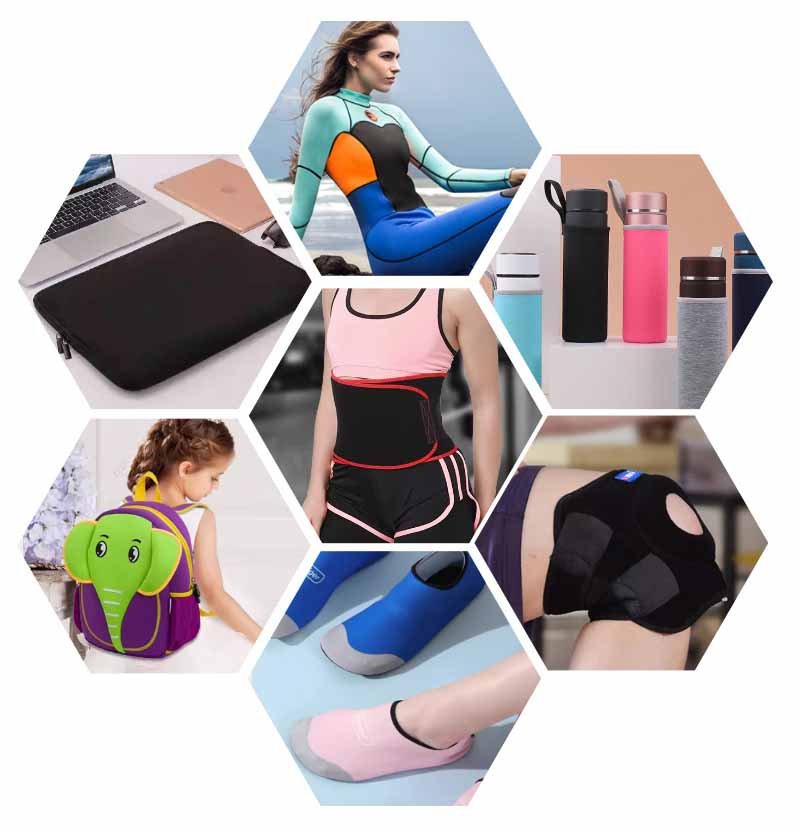
Why Choose Neoprene Products?
Neoprene is rarely selected just for appearance.
Brands choose it because it solves practical performance problems that standard textiles cannot handle at the same time—especially when products must be soft, protective, water-resistant, and comfortable against skin.
From a commercial perspective, neoprene often allows companies to:
- reduce product returns caused by damage or moisture
- increase perceived quality and retail price
- simplify internal structure by removing extra padding layers
These advantages directly influence profit margin, customer satisfaction, and long-term brand positioning.
Why are neoprene products considered durable?
Durability in neoprene products comes from a combination of elastic rubber foam and laminated textile surfaces rather than a single strong fiber.
Key durability mechanisms include:
Elastic recovery instead of permanent deformation
When compressed, quality neoprene rebounds toward its original shape.
This prevents long-term collapse in laptop sleeves, braces, and padding zones.
Closed-cell resistance to moisture damage
Because water penetration is limited, neoprene avoids:
- fiber swelling
- mildew growth inside structure
- stiffness after drying
This is especially important for gym, marine, and outdoor products.
Stable performance across temperature ranges
Neoprene maintains flexibility from cold to moderately high temperatures, which helps products remain usable in:
- winter outdoor sports
- hot car interiors
- coastal environments with salt exposure
Durability comparison with common bag materials
| Material | Compression Recovery | Moisture Resistance | Long-Term Shape Stability |
|---|---|---|---|
| Neoprene | High | Strong | Stable |
| Polyester fabric | Low | Medium | Depends on padding |
| EVA foam | Medium | Strong | Can crack over time |
| PU leather | Low | Medium | Surface aging risk |
For many brands, this durability translates into fewer warranty claims and stronger customer reviews, which matters more than small differences in material cost.
Why do users prefer neoprene for sports and outdoor gear?
Sports and outdoor environments expose products to sweat, movement, friction, and temperature change simultaneously.
Neoprene performs well here because it combines three user-visible sensations:
Soft compression without rigidity
Athletes often describe neoprene supports as:
- secure but flexible
- warm without overheating
- supportive without restricting motion
These sensations come from balanced foam density and stretch ratio, not just thickness.
Thermal comfort during activity
Neoprene slows heat loss while still allowing limited breathability through fabric lamination and panel design.
This balance is critical for:
- joint protection during training
- muscle warmth in recovery
- comfort during water exposure
Shock absorption for carried equipment
In outdoor bags, neoprene reduces vibration transferred to:
- electronics
- bottles
- fragile gear
This protective feel is one reason neoprene bags often achieve higher customer ratings than thin-fabric alternatives.
Are neoprene products environmentally friendly or recyclable?
Environmental impact is an increasingly common question from global brands.
Neoprene is a synthetic rubber, so it is not biodegradable in the traditional sense.
However, sustainability evaluation depends on full lifecycle thinking, not just raw material origin.
Key sustainability considerations
Long service life reduces replacement frequency
A durable neoprene product used for years may create less total waste than short-life alternatives replaced multiple times.
Material optimization during manufacturing
Modern factories reduce impact through:
- precise die-cut nesting to lower scrap rate
- recycled fabric laminations
- water-based adhesives instead of solvent systems
Emerging recycled and limestone-based neoprene options
Some suppliers now offer alternative foam formulations that reduce petroleum dependence while maintaining similar performance.
| Factor | Neoprene | Thin Polyester Bag |
|---|---|---|
| Average lifespan | Longer | Shorter |
| Replacement frequency | Lower | Higher |
| Structural protection | Strong | Weak |
| Total lifecycle waste | Often lower | Often higher |
For brands communicating sustainability to customers, durability + responsible production is often the most realistic and credible strategy.
How Are Neoprene Products Customized?
Customization is where neoprene becomes especially valuable for private-label brands and OEM development.
Because the material is engineered rather than woven, manufacturers can adjust structure, appearance, and function with high precision.
Successful customization depends on clear technical planning before sampling, not just visual design.
What customization options are available?
Neoprene products can be tailored across multiple dimensions:
Structural customization
- thickness selection based on protection or insulation
- density tuning for softness vs. support
- single-side or double-side fabric lamination
Visual customization
- full-color heat transfer printing
- screen printing or sublimation
- embossed or textured surface finishes
Functional customization
- antimicrobial lining for sweat environments
- reinforced panels for load-bearing zones
- waterproof seam constructions for marine use
| Custom Element | What It Controls | Typical Decision Driver |
|---|---|---|
| Thickness | protection & warmth | product category |
| Density | comfort vs. firmness | user experience |
| Fabric surface | look & abrasion resistance | brand positioning |
| Printing method | color detail & durability | logo complexity |
| Seam type | water resistance & strength | usage environment |
Understanding these variables early helps brands avoid repeated sampling cycles, saving both time and development cost.
How does private label / OEM / ODM work?
For most international clients, neoprene production follows a step-by-step collaboration process:
Concept discussion
Product use, target price, and quantity are clarified.
Material and structure proposal
Manufacturer recommends thickness, density, fabric, and construction.
Sampling stage
Prototype confirms:
- size accuracy
- comfort and appearance
- logo quality
Testing and adjustment
Weak points such as seams, odor, or deformation are corrected.
Mass production with quality control
Consistent materials and inspection standards ensure repeatability.
This structured workflow is essential for brands that want stable long-term supply rather than one-time production.
What quality assurance practices matter most?
Quality control in neoprene manufacturing focuses on performance stability, not just visual inspection.
Critical production checks
| Quality Area | Test Method | Risk if Ignored |
|---|---|---|
| Thickness tolerance | precision measurement | inconsistent support |
| Lamination strength | peel testing | surface separation |
| Color fastness | sweat & rub tests | staining or fading |
| Seam durability | tensile pull test | breakage during use |
| Odor evaluation | sealed storage test | customer complaints |
Factories with mature QA systems can significantly reduce:
- return rates
- negative reviews
- warranty costs
For global brands, this reliability is often more valuable than the lowest unit price.
Turning Ideas Into Market-Ready Neoprene Products
Neoprene products succeed when material science, ergonomic design, and manufacturing control work together.
Choosing the correct thickness, density, lamination, and seam structure is what transforms a simple concept into a product customers trust and reorder.
At Oneier, development is approached from a real-use perspective:
- matching specifications to actual environments like gyms, oceans, or clinics
- identifying weak points before mass production
- ensuring stable quality across repeat orders
With more than 18 years of experience in neoprene material R&D and product manufacturing, the team supports global brands through:
- fast sampling
- low-MOQ customization
- private label and OEM production
- consistent quality assurance
If you are planning to develop neoprene bags, koozies, sports supports, medical braces, wetsuits, or other custom neoprene products, the next practical step is a technical discussion based on your target market, price range, and performance goals.
Contact Oneier today to start your custom neoprene project and receive professional material and structure recommendations tailored to your brand.