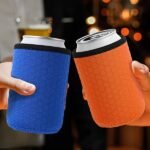
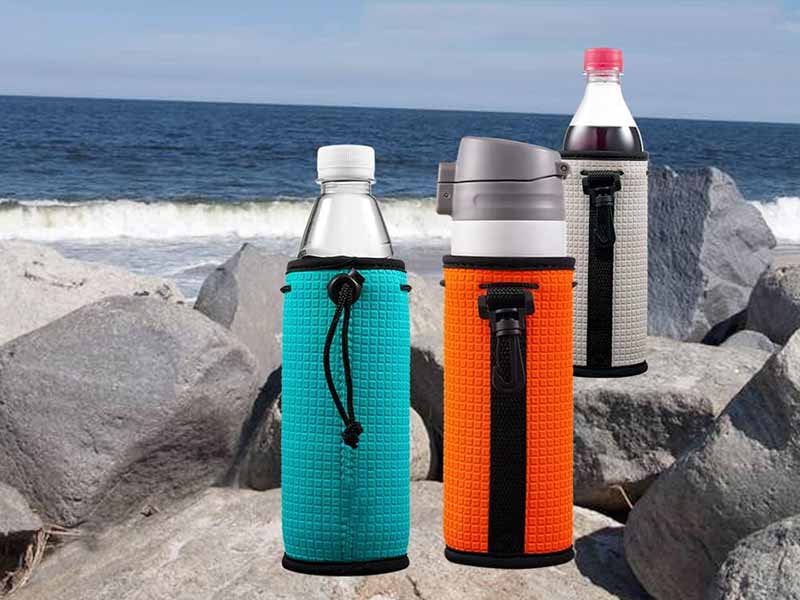
At first glance, a neoprene bottle cooler looks like one of the simplest products in the promotional and drinkware market. It is soft, light, easy to fold, and inexpensive to ship. That is exactly why many customers underestimate it. In real production, a bottle cooler is not just a sleeve wrapped around a drink. It is a fit-sensitive, print-sensitive, material-sensitive product. If the neoprene is too soft, the cooler loses shape. If the size is wrong by a few millimeters, the bottle either slides out or becomes too hard to insert. If the lamination is unstable, the print surface wrinkles or peels. If the seam construction is weak, the cooler may split after repeated use. Small details decide whether the product feels cheap or feels worth keeping.
Neoprene bottle coolers are made by laminating neoprene foam with fabric, printing the surface, cutting shaped panels, and assembling them through stitching, gluing, or both. Product quality depends on neoprene thickness, fabric quality, size accuracy, seam strength, and how well the cooler matches the bottle it is made for.
That is why experienced factories treat this product seriously even though the item itself looks simple. At Oneier, with more than 18 years of experience in neoprene material development and related product manufacturing, custom bottle coolers are developed with the same logic used in larger sewn neoprene products: start from the end use, control the material system, and keep bulk production stable. A bottle cooler may be small, but the difference between a giveaway product and a repeat-order product is often hidden in the production details.
What Is a Neoprene Bottle Cooler?
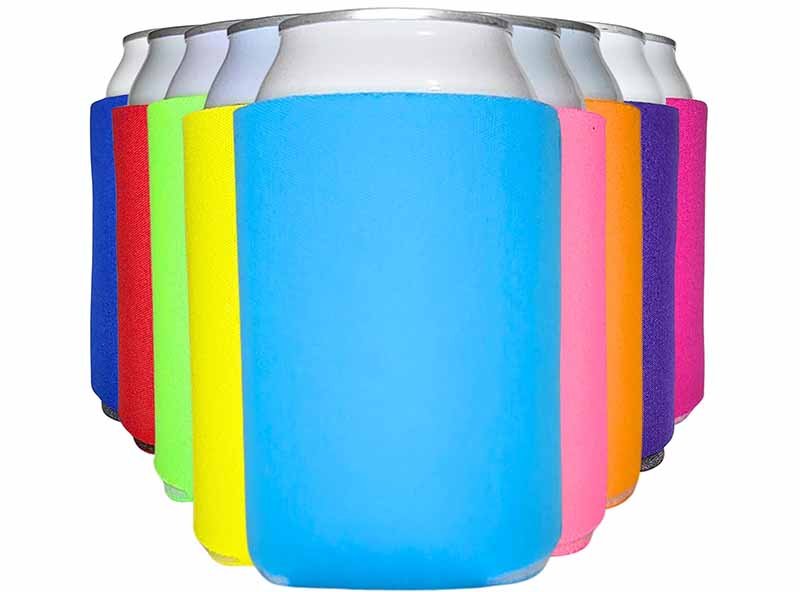
A neoprene bottle cooler is a soft insulating sleeve made to fit around bottles or cans to help reduce heat transfer, improve grip, reduce hand condensation, and provide a printable surface for branding. It is widely used for beer bottles, energy drinks, sports beverages, event promotions, and private label accessories.
What Does a Neoprene Bottle Cooler Do?
A neoprene bottle cooler does more than keep a drink feeling cooler for longer. Its real value comes from combining several functions in one low-cost product. For the end user, it helps slow temperature loss, reduces the wet feeling caused by surface condensation, improves grip, and adds a more finished look to the drink. For the customer developing the product, it also creates a practical branding tool with a large visible print area.
From a performance point of view, neoprene works because it is a foamed rubber material with trapped air inside the structure. That air layer helps slow the transfer of heat from the outside environment to the bottle. In ordinary use, the cooler does not actively refrigerate the drink, but it helps preserve the original cold temperature longer than an uncovered bottle. The effect becomes more noticeable in outdoor environments, especially in summer, at sporting events, camping trips, beach settings, and bar promotions.
The table below shows the main functional value of the product:
| Function | What It Improves | Why It Matters |
|---|---|---|
| Insulation | Slows warming of cold drinks | Better drinking experience outdoors |
| Condensation control | Reduces water on hands and tables | Cleaner use, less slipping |
| Grip | Makes bottles easier to hold | Better handling in humid or cold conditions |
| Surface protection | Adds cushioning around glass or metal | Reduces scratches and minor impact |
| Branding | Creates printable display space | Useful for promotions and retail identity |
A good cooler is therefore not only about insulation. If the fit is good and the surface looks clean, people keep using it. That matters because repeated use gives a much longer branding life than a disposable promotional item.
Why Choose a Neoprene Bottle Cooler?
Neoprene is widely chosen because it gives a stronger mix of flexibility, insulation, softness, and print value than many lower-cost alternatives. In this category, customers often compare neoprene with simple foam, felt, knitted fabric, or single-layer polyester sleeves. Those options may reduce cost, but they often lose the performance and product feel that make people actually want to use the cooler.
The main advantage of neoprene is balance. It stretches enough to fit around containers snugly, but it still has body. It feels soft in the hand, but it also offers a mild protective effect for bottles. It supports sublimation printing well when laminated with polyester fabric, which means logos, colors, and full-surface artwork can be reproduced clearly. That is one reason neoprene coolers are common in sports marketing, beverage promotions, souvenir sales, and branded merchandise.
A material comparison makes this easier to understand:
| Material | Fit Flexibility | Insulation | Surface Quality | Durability | Relative Cost |
|---|---|---|---|---|---|
| Neoprene | High | High | High | High | Medium |
| EVA / PE foam | Medium | Medium | Low to medium | Low | Low |
| Felt | Low | Low | Medium | Medium | Low |
| Single-layer fabric | Low | Low | Medium | Medium | Low |
For many customers, neoprene is not chosen because it is the absolute cheapest route. It is chosen because it gives a more complete product. The cooler feels better, looks better, and generally holds up better in repeated use. That makes it more suitable for private label and retail-oriented projects, not just mass giveaways.
At Oneier, customers often choose neoprene because they want the product to do two jobs at once: function as a drink accessory and represent their brand well. That only works when the material feels right and the print quality stays stable in bulk.
What Types of Neoprene Bottle Coolers Exist?
Neoprene bottle coolers come in several construction types, and the right style depends on the target bottle, budget, branding goals, and sales channel. A lot of customers enter this category thinking there is only one standard cooler, but the market is more segmented than that. A cooler made for a glass beer bottle is not necessarily the best choice for a stainless steel sports bottle or a promotional canned drink.
The most common structures include sleeve coolers, zipper coolers, flat-pack foldable coolers, base-supported coolers, and drawstring-top coolers. Each has its own strengths and cost logic.
| Cooler Type | Main Structure | Strength | Limitation |
|---|---|---|---|
| Sleeve cooler | Tubular body, no zipper | Lowest cost, easy production | Less flexible for insertion |
| Zipper cooler | Side zipper opening | Better usability, cleaner fit | Higher labor and trim cost |
| Fold-flat cooler | Flat shape with collapsible body | Easy mailing, event use | Less structured feel |
| Base-supported cooler | Added bottom panel | Better stability and appearance | More material and sewing steps |
| Drawstring cooler | Adjustable top closure | Works across more bottle heights | More parts, more assembly |
Sleeve coolers are often used when cost and production speed matter most. Zipper coolers are usually preferred for glass beer bottles because the zipper makes insertion and removal easier and helps keep the cooler body fitted around the bottle. Base-supported styles feel more premium and stand better on tables, which helps in retail display or branded gift sets.
The important point is that style selection should begin with use. Is the product for bars, outdoor events, beverage brands, sports teams, e-commerce, or gift packaging? Is the goal the lowest landed cost, the best appearance, or the best daily usability? When the structure is matched to the real application, the cooler performs better and the project becomes easier to price correctly.
What Materials Are Used in Neoprene Bottle Coolers?
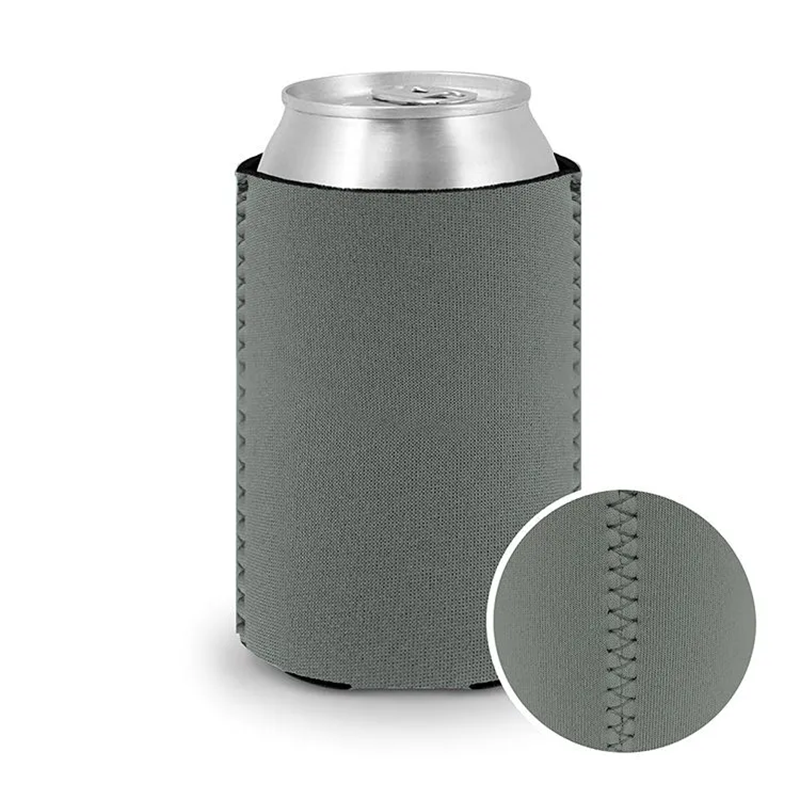
Neoprene bottle coolers are usually made from laminated neoprene foam, outer fabric layers such as polyester or nylon, seam materials such as bonded thread or glue, and optional accessories such as zippers, binding tape, pullers, and bottom panels. Material choices directly affect fit, print quality, feel, durability, and unit cost.
Which Neoprene Is Used for Bottle Coolers?
Not all neoprene performs the same way. The two most important material variables in bottle cooler production are thickness and density. These two factors affect how the cooler feels in the hand, how tightly it fits the bottle, how well it insulates, and how easily it can be sewn or folded.
In most bottle cooler projects, the common thickness range is 2 mm to 5 mm. The choice depends on the target product level and bottle type.
| Thickness | Product Feel | Main Advantage | Common Use |
|---|---|---|---|
| 2 mm | Light, flexible | Lower cost, easier folding | High-volume promotions |
| 3 mm | Balanced | Good fit + good insulation | Most standard cooler projects |
| 5 mm | Thick, substantial | Premium hand feel, stronger insulation | High-end cooler styles |
A 3 mm neoprene body is often the most practical choice because it balances cost, flexibility, and visual body. It is thick enough to feel like a real product but still workable for folding, stitching, and packing. A 2 mm cooler may reduce cost and shipping weight, but if the bottle is heavy or the product needs a premium appearance, it may feel too thin. A 5 mm cooler feels richer and insulates better, but it raises both raw material and freight cost.
Density matters as much as thickness. Low-density neoprene can feel soft at first, but it may stretch too much, sag after use, or lose shape. Higher-density neoprene feels firmer, grips the bottle better, and generally supports cleaner structure. For customers trying to hit a specific price point, this is one area where careful material selection makes a large difference. Two coolers may both be described as “3 mm neoprene,” but they may not perform the same in actual use.
At Oneier, neoprene selection is usually based on bottle size, target market, print method, and retail level. That approach gives a better match between product feel and cost instead of using one standard material for every cooler.
What Fabric Layers Are Used in Neoprene Bottle Coolers?
Neoprene bottle coolers are usually not made from exposed neoprene alone. The neoprene foam is normally laminated with fabric, and that outer fabric plays a big role in printing, appearance, and wear resistance. In production, the lamination layer is not a minor detail. It can decide whether the print looks sharp, whether the surface pills over time, and whether the cooler keeps a clean retail look after repeated use.
The most common laminated fabrics are polyester, nylon, and stretch fabrics such as lycra blends.
| Fabric Layer | Main Advantage | Best For | Trade-Off |
|---|---|---|---|
| Polyester | Best print performance | Sublimation artwork, full color | Standard durability |
| Nylon | Stronger surface feel | More rugged or premium use | Less ideal for sublimation |
| Lycra / stretch knit | Smooth, flexible finish | Soft premium styles | Higher material sensitivity |
Polyester is the most widely used because it performs very well in sublimation printing. That makes it ideal for logos, event graphics, all-over patterns, gradients, and vivid color work. For promotional projects and branded beverage accessories, polyester-laminated neoprene is often the most cost-effective choice. Nylon gives a stronger and slightly more technical surface feel, which can work well in projects where abrasion resistance matters more than full-color printing.
Lamination quality is critical. If the bond between the fabric and neoprene is weak, the surface may bubble, wrinkle, or separate during use or after exposure to heat. If the surface tension is uneven, the print may distort. For this reason, lamination is not only a material issue but also a quality-control issue. Good lamination gives a flat printable face and more stable assembly later in production.
Customers often focus on artwork and overlook the importance of fabric layer choice. But in many cooler projects, the outer fabric is what the user sees first and touches first. It strongly shapes first impressions of the product.
What Parts Improve Neoprene Bottle Coolers?
A bottle cooler may look like a simple neoprene shell, but the supporting parts do a lot of work. In real bulk production, many complaints come not from the neoprene itself but from the secondary components: weak zippers, rough seam edges, loose thread ends, unstable bottoms, or poor binding. These details affect both usability and product life.
The most common supporting parts include:
- Zippers for side-open cooler styles
- Bonded thread for sewn seams
- Binding tape for edge finishing
- Rubber or metal zipper pullers
- Bottom panels for structured styles
- Glued joints in seamless or low-profile designs
The effect of these parts is easier to see in a production table:
| Component | Main Role | Low-Grade Risk | Better Production Result |
|---|---|---|---|
| Zipper | Easier bottle insertion | Jamming, tooth breakage | Smooth open-close performance |
| Thread | Holds seams together | Splitting at seam lines | Better long-term seam strength |
| Binding | Protects raw edges | Curling, fraying appearance | Cleaner edges, better wear resistance |
| Bottom panel | Supports standing shape | Collapse, poor bottle stability | Better table presence and structure |
| Puller | Improves usability | Cheap feel, easy breakage | Better user comfort and appearance |
For example, a side zipper cooler may look attractive in samples, but if the zipper tape and stitching are not aligned correctly, the cooler can twist or bulge. A flat sleeve cooler may look simple, but if the seam allowance is too narrow, it may open after repeated stretching. A bottom-supported cooler may stand beautifully on a shelf, but if the base board is too weak, it can distort quickly in shipment.
This is why good cooler manufacturing is not only about the main sheet material. The full bill of materials matters. A better result usually comes from balanced component selection, not from upgrading only one visible part.
How Do Materials Affect Bottle Cooler Cost?
Material decisions directly affect pricing, but the real cost picture is wider than raw neoprene price alone. When customers compare quotations, they often focus on thickness or print count and miss the combined effect of lamination, zipper choice, edge finishing, labor difficulty, packing method, and order quantity. In small products like bottle coolers, even minor component changes can shift the final unit price noticeably.
A simplified cost structure often looks like this:
| Cost Driver | Lower-Cost Route | Higher-Cost Route |
|---|---|---|
| Neoprene thickness | 2 mm | 3–5 mm |
| Surface fabric | Standard polyester | Higher-grade polyester / nylon |
| Construction | Simple sleeve | Zipper + bottom + binding |
| Printing | Basic 1-color print | Full sublimation |
| Packing | Bulk pack | Individual retail pack |
A sleeve cooler with 2 mm neoprene and simple construction may be ideal for event giveaways and volume promotions. A zipper cooler with 3 mm laminated neoprene, full-surface print, and a reinforced bottom may cost more, but it gives a much stronger product impression and is more suitable for retail, e-commerce, and premium beverage promotions.
Customers who plan well usually start with a target selling channel and target margin, then build the material route backward from there. That is often more effective than designing the most complex product first and then trying to reduce cost later. At Oneier, customers often share target bottle size, order quantity, logo idea, and market position first, then the material route is matched to those goals. That process usually saves more time and reduces sample revisions.
In bottle cooler manufacturing, cost control is not just about making the product cheaper. It is about choosing the right material system for the right product level so the cooler performs well and still leaves room for margin.
How Are Neoprene Bottle Coolers Designed?
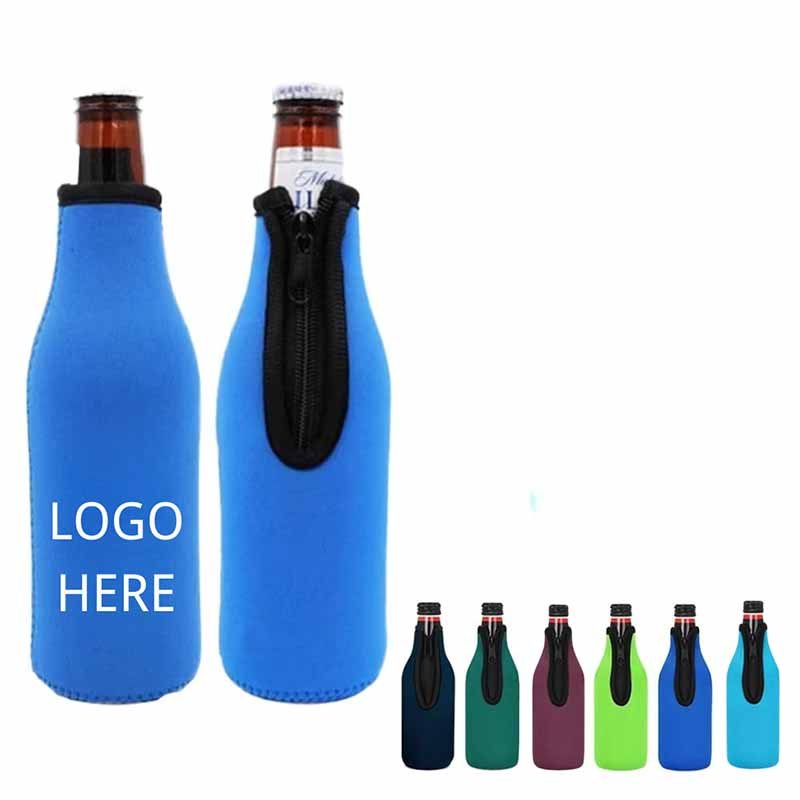
Neoprene bottle cooler design is the process of turning a specific bottle size and usage scenario into a structure that fits tightly, feels comfortable, and can be produced consistently in bulk. A good design is not just about shape—it is about controlling fit, stretch, seam position, and material behavior so that every unit performs the same.
How Are Neoprene Bottle Cooler Sizes Measured?
Size measurement is the most critical step in cooler design. Even a small error can lead to poor fit, which is one of the most common reasons for product complaints.
A bottle cooler must match three key dimensions:
- Bottle diameter
- Bottle height
- Neck shape (for beer bottles or specialty bottles)
Typical bottle reference sizes:
| Bottle Type | Diameter | Height | Design Fit |
|---|---|---|---|
| Standard beer bottle | 6.5–6.8 cm | 23–25 cm | Tight fit with stretch allowance |
| Aluminum can (330ml) | 6.5 cm | 12 cm | Short sleeve design |
| Sports bottle | 7–9 cm | 20–28 cm | Flexible or zipper design |
Because neoprene stretches, the pattern is usually designed slightly smaller than the bottle size.
Standard adjustment:
- 3–5% negative tolerance (for snug fit)
Example:
- Bottle diameter: 6.6 cm
- Cooler internal diameter design: ~6.3–6.4 cm
If the fit is too loose:
- The cooler slides down
- The product feels cheap
If too tight:
- Hard to insert
- Seams may overstretch
At Oneier, we usually test fit with real bottles during sampling to ensure accuracy before bulk production.
How Are Neoprene Bottle Cooler Shapes Made?
The shape of a bottle cooler is not random. It is defined by how the product will be used and how it will be manufactured.
Common shape structures:
| Shape Type | Description | Production Impact |
|---|---|---|
| Straight tube | Same width top to bottom | Simplest, lowest cost |
| Tapered shape | Narrow top, wider bottom | Better fit for bottles |
| Flat-fold design | Foldable with glued base | Good for shipping |
| Structured base | Added bottom panel | Premium look |
Tapered shapes are more common for glass bottles because they follow the natural bottle form. However, they require more precise cutting and alignment during sewing.
Flat-fold designs are popular for promotions because they:
- Save shipping space
- Reduce packaging cost
Structured base designs:
- Improve stability
- Increase perceived value
- Add production steps and cost
The choice depends on:
- Target price
- Sales channel (retail vs promotion)
- Branding requirements
How Are Logos Added to Neoprene Bottle Coolers?
Logo application is one of the most important parts of product development because it directly affects how the product looks in the market.
Common logo methods:
| Method | Effect | Best Use |
|---|---|---|
| Sublimation printing | Full-color, all-over design | Promotional & retail |
| Screen printing | Solid colors | Simple logos |
| Heat transfer | Multi-color logos | Medium volume |
| Embroidery | Textured look | Premium branding |
| Rubber patch | 3D logo | High-end products |
Sublimation printing is the most widely used because it allows:
- Full coverage designs
- No color limits
- No cracking or peeling
Key production point:
- Printing is done before cutting
This ensures:
- Accurate pattern alignment
- Consistent color across panels
A common issue is color mismatch between samples and bulk. This usually comes from:
- Different fabric batches
- Incorrect temperature control during printing
At Oneier, we control:
- Color calibration
- Heat transfer temperature (180–200°C)
- Printing time consistency
to maintain stable results.
How Are Neoprene Bottle Coolers Manufactured?
Neoprene bottle cooler manufacturing is a step-by-step process that includes printing, cutting, sewing or gluing, shaping, and quality inspection. Each stage must be controlled carefully to ensure consistent fit, clean appearance, and long-term durability.
How Is Neoprene Prepared for Bottle Coolers?
Before cutting begins, neoprene sheets must be laminated and printed.
The process includes:
- Neoprene + fabric lamination
- Surface printing (usually sublimation)
- Heat setting
Key parameters:
| Process | Standard Range |
|---|---|
| Lamination bonding strength | ≥ 2.5 N/cm |
| Printing temperature | 180–200°C |
| Press time | 40–60 seconds |
Important points:
- Uneven lamination leads to surface bubbles
- Incorrect temperature leads to color fading
- Poor alignment affects final appearance
High-quality preparation ensures:
- Smooth surface
- Strong bonding
- Accurate colors
How Are Neoprene Bottle Coolers Cut?
Cutting transforms printed sheets into product panels.
Methods used:
- Die cutting (most common)
- CNC cutting (for precision or small runs)
Cutting must consider:
- Stretch direction of neoprene
- Pattern alignment with print
- Edge cleanliness
Tolerance:
- ±1 mm for quality production
If cutting is inaccurate:
- Seams misalign
- Shapes deform
- Fit becomes inconsistent
For large orders, steel dies are used to ensure:
- Speed
- Consistency
- Cost efficiency
How Are Neoprene Bottle Coolers Sewn or Glued?
Assembly is where the product takes its final form.
Two main methods:
| Method | Strength | Appearance | Cost |
|---|---|---|---|
| Stitching | High | Visible seams | Medium |
| Gluing | Smooth | Seamless look | Higher |
Stitching process includes:
- Panel alignment
- Seam stitching (single or double)
- Edge binding
Gluing process includes:
- Adhesive application
- Heat pressing
- Edge finishing
Most products use stitching + binding because:
- Stronger
- More cost-effective
Critical stress areas:
- Side seam
- Bottom joint
- Zipper connection
Reinforcement methods:
- Double stitching
- Edge binding
- Overlock stitching
A weak seam is one of the fastest ways for a product to fail in real use.
How Are Neoprene Bottle Coolers Checked?
Quality control ensures that every batch meets production standards.
Inspection includes:
| Check Item | Standard |
|---|---|
| Size tolerance | ±1–2 mm |
| Print alignment | Within 2 mm |
| Seam strength | No opening under stretch |
| Surface quality | No bubbles or defects |
Additional tests:
- Stretch test (simulate bottle insertion)
- Wash test (color durability)
- Load test (seam strength)
Typical defect control:
- Standard production: <3%
- Premium orders: <1.5%
At Oneier, QC is done at three stages:
- During production
- After assembly
- Before shipment
This reduces:
- Return rates
- Customer complaints
- Brand risk
Which Neoprene Bottle Coolers Sell Best?
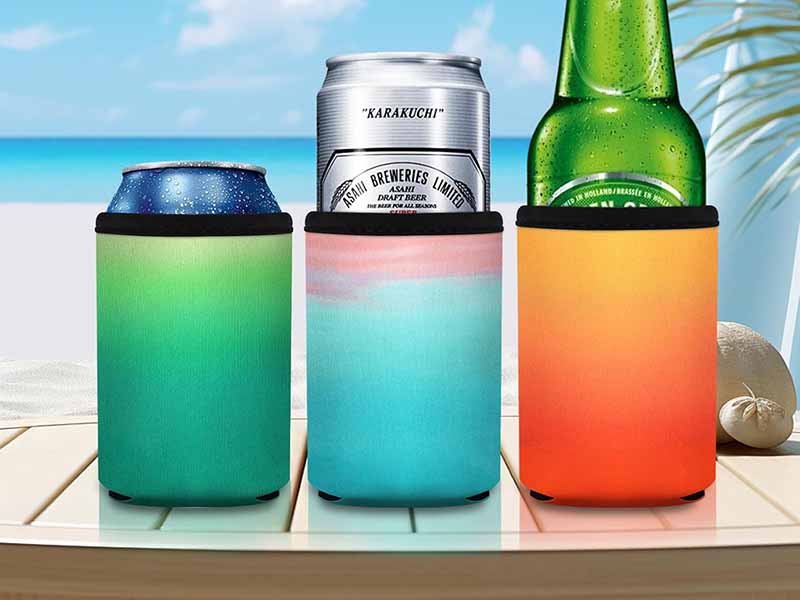
The best-selling neoprene bottle coolers are not simply the cheapest ones. Products that perform well in the market usually balance fit accuracy, print quality, usability, and perceived value. In many cases, a slightly higher-cost product sells better because it feels more premium and lasts longer.
Which Neoprene Bottle Cooler Styles Are Popular?
Different markets prefer different styles, but several product types consistently perform well across Amazon, retail stores, and promotional channels.
| Style | Key Feature | Target Market | Price Level |
|---|---|---|---|
| Standard sleeve cooler | Simple tube design | High-volume promotions | Low |
| Zipper cooler | Easy insertion | Beer brands / retail | Medium |
| Base-supported cooler | Stable standing | Gift / premium market | Medium–high |
| Slim can cooler | Fits narrow cans | Beverage brands | Medium |
| Collapsible cooler | Flat shipping | Events / giveaways | Low |
Zipper coolers have become one of the most stable sellers because they solve a real problem: easy insertion and removal. Sleeve coolers are still widely used due to their low cost, but they face strong competition and price pressure.
Base-supported coolers are growing in demand because they:
- Look more structured
- Stand upright on tables
- Improve perceived value
For customers targeting e-commerce platforms, appearance and usability often matter more than saving a few cents in production.
Are Zipper Neoprene Bottle Coolers Better?
Zipper coolers are not always better, but they offer clear advantages in usability.
Comparison:
| Feature | Sleeve Cooler | Zipper Cooler |
|---|---|---|
| Ease of use | Medium | High |
| Production cost | Low | Medium |
| Fit flexibility | Low | High |
| User experience | Basic | Better |
Zipper coolers are preferred when:
- The bottle shape is not standard
- The product targets retail or gifting
- The user wants quick access
However, zipper quality becomes critical. Poor zippers can:
- Break under stress
- Cause alignment issues
- Reduce product lifespan
At Oneier, we use tested zipper suppliers and reinforce zipper areas to ensure durability.
Which Neoprene Bottle Coolers Fit Different Uses?
Different use scenarios require different designs. One design cannot fit all markets.
| Use Case | Recommended Type | Key Requirement |
|---|---|---|
| Beer brands | Zipper cooler | Easy use + branding |
| Sports events | Sleeve cooler | Low cost + bulk |
| Outdoor activities | Thick neoprene | Better insulation |
| Retail products | Base-supported | Premium look |
| Promotional giveaways | Foldable cooler | Easy shipping |
For example:
- A promotional campaign may prioritize cost and volume
- A retail product must focus on appearance and durability
- Outdoor products require stronger materials
The most successful products clearly match one main use case instead of trying to cover everything.
How to Choose a Neoprene Bottle Cooler Manufacturer?
Choosing the right manufacturer is one of the most important steps in product development. A good factory helps you avoid common mistakes, control cost, and ensure consistent quality in bulk production.
What Should You Check in Neoprene Bottle Cooler Production?
When selecting a manufacturer, focus on real capabilities rather than only price.
Key factors:
- Neoprene material experience
- Lamination and printing control
- Cutting accuracy
- Sewing or gluing quality
- Quality control system
A factory without neoprene experience may struggle with:
- Material stretch behavior
- Print alignment
- Seam durability
At Oneier, we combine:
- Material R&D
- Product development
- Manufacturing
This ensures better control from start to finish.
How Do MOQ and Lead Time Work for Neoprene Bottle Coolers?
MOQ and lead time directly affect your business flexibility.
Typical production standards:
| Item | Standard Range |
|---|---|
| MOQ | 100–500 pcs |
| Sample time | 5–7 days |
| Production time | 20–30 days |
Lower MOQ helps:
- Test new designs
- Reduce inventory risk
Faster lead time helps:
- Respond to market demand
- Launch products quickly
However, very low MOQ may increase unit cost due to setup and material sourcing.
At Oneier, we support:
- Low MOQ customization
- Fast sample turnaround
- Stable production capacity
Why Work With Oneier for Neoprene Bottle Coolers?
An experienced manufacturer does more than produce—it helps improve your product before it reaches the market.
Oneier advantages:
- 18+ years neoprene manufacturing experience
- Strong lamination and printing control
- Wide customization options (thickness, size, logo)
- Free design support
- Fast sampling (5–7 days)
- Stable quality control (<2% defect rate)
We help customers avoid common problems such as:
- Poor fit design
- Weak seams
- Color inconsistency
- Unbalanced cost structure
This reduces development risk and improves product success rate.
Start Your Neoprene Bottle Cooler Project with Oneier
If you are planning to develop a neoprene bottle cooler, the most important step is choosing a factory that understands both material and product.
At Oneier, we help turn your idea into a real product with:
- Free design based on your bottle size and target market
- Material recommendations to balance cost and quality
- Fast sample development in 5–7 days
- Low MOQ for flexible testing
- Reliable bulk production
Whether you are building a promotional product, launching a retail item, or creating a private label brand, we can support you from concept to delivery.
Tell us your bottle size, target price, and design idea — we will help you create a neoprene bottle cooler that fits your market and stands out.
Contact Oneier today to start your custom project.