
If you search “how big is a koozie,” you’ll probably expect a quick number—height, width, maybe diameter. But in real life, koozie sizing is far more nuanced than most people realize. A koozie that’s just a few millimeters too wide won’t insulate properly. One that’s too tight may wrinkle, distort printed logos, or even tear at the seam. And when it comes to custom branding, size directly affects how your logo looks, how long it lasts, and how premium the product feels in hand.
Koozies have evolved from simple foam sleeves into engineered neoprene products used by beverage brands, event organizers, sports teams, medical suppliers, and outdoor companies. Today’s market includes standard 12 oz cans, slim cans, tall cans, bottles, energy drinks, and even specialty containers—each requiring different dimensions to perform correctly. That’s why “one-size-fits-all” is rarely the right answer.
For buyers and brands, understanding koozie size isn’t just about fit—it’s about insulation efficiency, user experience, print accuracy, and production consistency. This becomes even more important when working with neoprene, where material thickness, stretch, and seam placement all influence the final size.
A standard koozie is designed to fit a 12 oz can and typically measures about 4 inches (10–10.5 cm) tall with a flat width of around 4 inches. Slim koozies, tall cans, and bottles require different dimensions. Proper koozie sizing affects insulation, fit, and print quality, especially for custom neoprene koozies used in branding and OEM production.
Once you understand how koozie sizing really works, choosing—or customizing—the right one becomes much easier.
What Is a Koozie
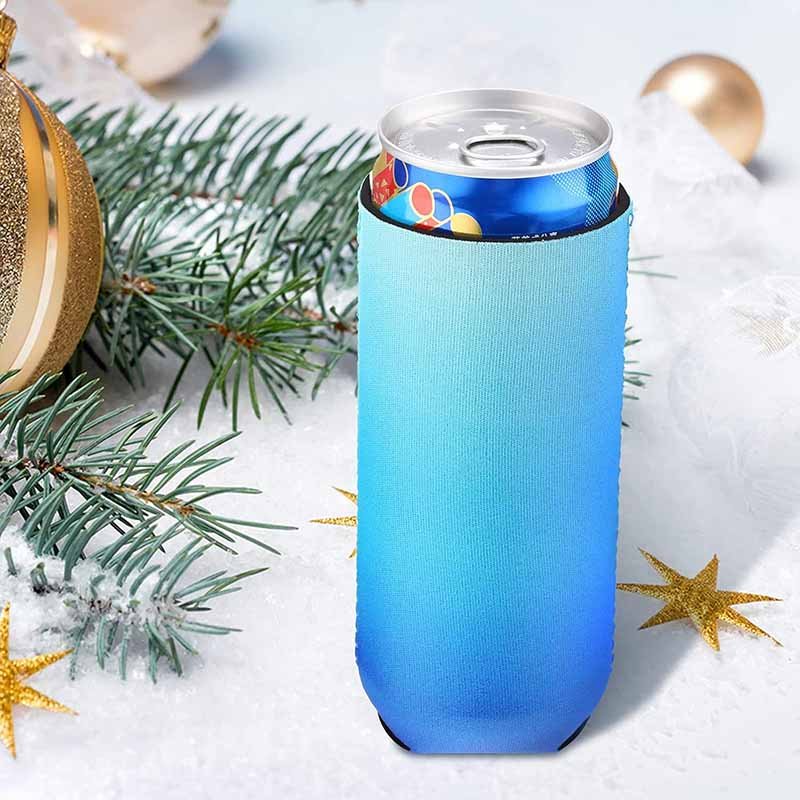
A koozie is an insulating sleeve designed to keep beverages cold or hot by reducing heat transfer between the drink container and the surrounding air. It is most commonly used for cans and bottles and is typically made from foam or neoprene. A properly sized koozie improves temperature retention, prevents condensation, and provides a comfortable grip for the user.
What does the term “koozie” mean?
“Koozie” originally started as a brand name, but over time it has become a widely accepted generic term—especially in the U.S.—for beverage insulators. In professional manufacturing and international trade, koozies may also be called:
- Can coolers
- Beverage sleeves
- Drink insulators
- Neoprene can holders
Despite the different names, the function remains the same: temperature control and user comfort.
What materials are koozies made from?
The two most common koozie materials are:
- Foam (EVA or PU) – lightweight and low cost
- Neoprene (scuba fabric) – flexible, durable, and high-performance
Data insight:
Neoprene koozies can retain cold temperatures 20–30% longer than basic foam koozies due to their closed-cell structure, which slows heat transfer and resists moisture absorption.
This performance advantage is why Oneier focuses on neoprene-based koozies for custom and OEM production.
Are koozies only for cans, or also for bottles and other containers?
Koozies are no longer limited to standard 12 oz cans. Today they are widely used for:
- Slim cans (energy drinks, hard seltzers)
- Tall cans (16 oz, 24 oz)
- Glass and aluminum bottles
- Tumblers and travel mugs
- Medical and specialty containers
Each container type requires different dimensions and construction, which is why custom sizing has become increasingly important.
How does a koozie actually work?
A koozie works by reducing heat transfer in three ways:
- Insulation – the material traps air, slowing temperature change
- Barrier protection – it reduces direct contact with warm hands
- Condensation control – it absorbs or blocks moisture
Data insight:
A well-fitted neoprene koozie can keep a cold beverage cold 15–25% longer than an uncovered can under typical outdoor conditions.
Why does fit and size matter for a koozie?
Fit is just as important as material.
- A loose koozie allows air gaps, reducing insulation
- An overly tight koozie causes seam stress and logo distortion
Proper sizing ensures:
- Maximum surface contact
- Better temperature retention
- Longer product lifespan
This is why koozie size is a critical design factor, not an afterthought.
How are koozies commonly used today?
Koozies are used across multiple industries:
- Beverage brands and breweries
- Sports teams and fan merchandise
- Corporate promotions and events
- Outdoor and lifestyle brands
- Medical and wellness applications
In many cases, the koozie is not just a functional item, but also a branding and marketing tool.
What Is the Standard Size of a Koozie

The standard size of a koozie is designed to fit a 12 oz (355 ml) beverage can. It typically measures about 4–4.2 inches (10–10.5 cm) in height and approximately 4 inches (10 cm) in flat width. When wrapped, this size fits snugly around a standard can, providing effective insulation, grip, and print visibility.
What is the most common standard koozie size for a 12 oz can?
The 12 oz can koozie is the industry benchmark.
Typical dimensions
- Height: 4–4.2 in (10–10.5 cm)
- Flat width: ~4 in (10 cm)
- Wrapped diameter (internal): ~2.5 in (6.5 cm)
This size has been standardized because:
- It fits most beer and soft drink cans
- It balances insulation with ease of insertion
- It provides sufficient space for branding
Data insight:
Over 70% of global koozie orders are still based on this 12 oz standard size.
Why is flat width used instead of diameter in manufacturing?
Manufacturers measure koozies flat, before stitching or bonding.
Reasons:
- Flat width is easier to control during cutting
- It accounts for seam allowance
- It allows accurate logo placement planning
Data insight:
A flat-width tolerance of ±3 mm is critical. Deviations beyond this can noticeably affect fit and logo alignment, especially in neoprene koozies with limited stretch.
How does standard size change with neoprene thickness?
Material thickness directly affects internal fit.
| Neoprene Thickness | Pattern Adjustment Needed |
|---|---|
| 2 mm | Minimal |
| 3 mm | Standard |
| 4–5 mm | Increase flat width by 3–6 mm |
Data insight:
Without width compensation, increasing neoprene thickness from 3 mm to 5 mm can reduce internal diameter by up to 10%, making the koozie feel too tight.
This is why professional factories like Oneier adjust patterns based on material thickness.
Is the “standard size” universal worldwide?
Not entirely.
While the 12 oz can standard dominates in the U.S., other markets vary:
- Europe: more 330 ml cans
- Asia: mixed can and bottle usage
- Australia: wider variety of bottle shapes
However, the 12 oz koozie size remains the reference point, with regional adjustments made as needed.
How does standard koozie size affect printing and design?
Standard size also defines design limits.
- Typical safe print area: 3 × 3 in (7.5 × 7.5 cm)
- Designs placed too close to seams risk distortion
- Bottom curvature reduces usable print space
Data insight:
Logos printed within the safe area show 20–30% lower distortion rates after repeated use compared to edge-adjacent prints.
When is a standard koozie size not the right choice?
Standard size may not work when:
- Using slim cans
- Using tall cans (16 oz / 24 oz)
- Using bottles or tumblers
- Using thick neoprene without adjustment
In these cases, custom sizing is recommended to maintain performance and appearance.
Standard Koozie Size Reference Table
| Parameter | Standard 12 oz Koozie |
|---|---|
| Container | 12 oz can |
| Height | 4–4.2 in (10–10.5 cm) |
| Flat width | ~4 in (10 cm) |
| Material | Foam or neoprene |
| Safe print area | ~3 × 3 in |
Which Koozie Dimensions Matter
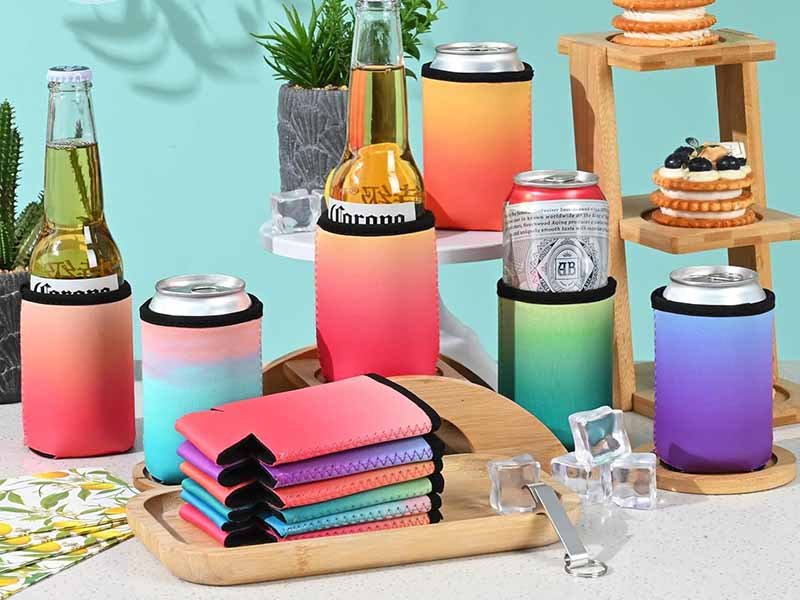
The most important koozie dimensions are height, flat width, internal diameter, and material thickness. These measurements determine how well the koozie fits the container, how effective the insulation is, and whether printed designs remain clear and undistorted. Accurate sizing is especially critical for neoprene koozies, which rely on precise fit rather than excessive stretch.
How does koozie height affect performance?
Koozie height controls coverage and insulation efficiency.
- Too short → exposed can surface, faster warming
- Too tall → difficult insertion and removal
Typical ranges
- Standard 12 oz can: 4–4.2 in (10–10.5 cm)
- Slim cans: 5–5.5 in (12.5–14 cm)
Data insight:
Koozies that cover at least 85–90% of the can height maintain cold temperature 15–20% longer than shorter sleeves under identical conditions.
Why is flat width more important than diameter in production?
Manufacturers cut koozies flat, then stitch or bond them.
- Flat width determines final internal diameter
- It accounts for seam allowance and material thickness
Standard reference
- 12 oz can koozie flat width: ~4 in (10 cm)
Data insight:
A flat-width error of just ±3 mm can lead to loose grip or excessive tightness, especially with neoprene that stretches less than foam.
How does internal diameter affect grip and insulation?
Internal diameter defines how tightly the koozie hugs the container.
- Loose fit → air gaps, poor insulation
- Over-tight fit → seam stress, logo distortion
Data insight:
Neoprene koozies with a snug internal diameter retain cold 15–25% longer than loose-fitting designs due to better surface contact.
Why does neoprene thickness change effective size?
Neoprene thickness reduces internal space.
| Neoprene Thickness | Typical Impact |
|---|---|
| 2 mm | Minimal change |
| 3 mm | Industry standard |
| 4–5 mm | Internal diameter reduced by 6–10% |
Without width compensation, thicker neoprene can make a standard koozie feel too tight.
This is why pattern width must be adjusted based on thickness.
How does seam allowance influence final dimensions?
Seam allowance is often overlooked.
- Wider seams reduce internal diameter
- Inconsistent seams cause uneven fit
Data insight:
Controlled seam allowance improves size consistency by 20–30% across production batches.
Professional factories standardize seam width to maintain repeatable sizing.
Do design and printing requirements affect dimension choices?
Yes—branding depends on size accuracy.
- Seam proximity increases distortion risk
- Curved bottoms reduce usable print area
Data insight:
Designs placed within the defined safe area show 20–30% less distortion after repeated use compared to edge-adjacent prints.
Dimension Priority Table
| Dimension | Why It Matters |
|---|---|
| Height | Controls coverage & insulation |
| Flat width | Defines internal diameter |
| Internal diameter | Determines grip & performance |
| Material thickness | Reduces internal space |
| Seam allowance | Affects consistency |
| Print area | Impacts branding quality |
How to Choose the Right Koozie Size
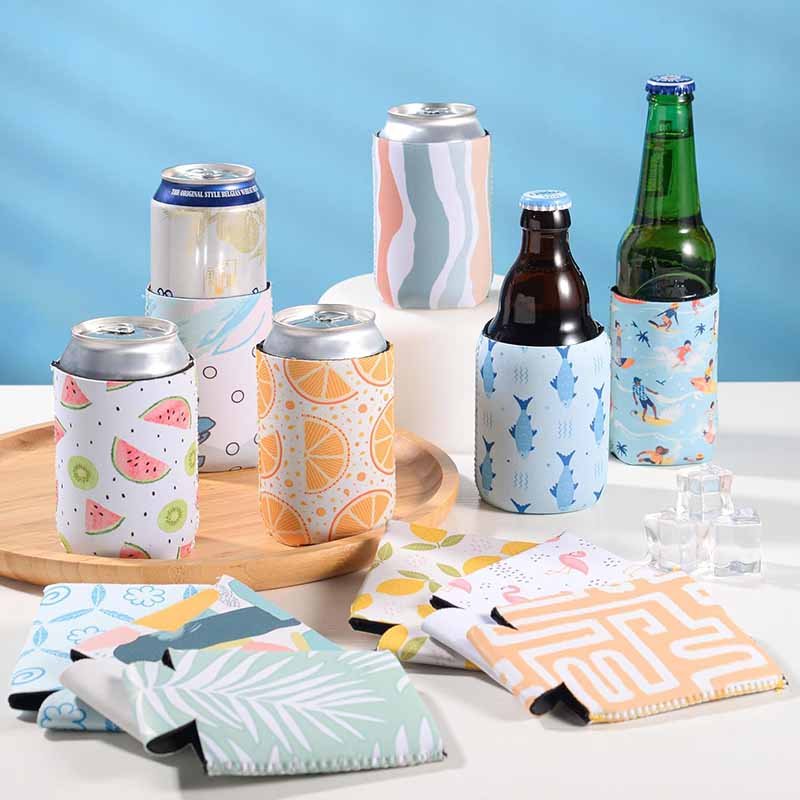
To choose the right koozie size, measure your container’s height and diameter (including the widest point), then match it to a standard, slim, tall, or bottle-specific koozie. The best koozie size is snug without forcing the container in, maximizing surface contact for insulation and preventing print distortion. Neoprene koozies require more precise sizing than foam because thickness and seam allowance affect internal diameter.
How do you measure a can or bottle for a koozie?
Use a ruler or caliper and capture three measurements:
- Height (H): base to top lip
- Diameter at the widest point (Dmax): don’t assume the base is widest
- Base diameter (Db): useful for tapered bottles
Quick tip:
If you don’t have calipers, wrap a string around the widest point to get circumference (C), then compute:
D = C ÷ π (3.14)
Data insight:
Most sizing errors come from measuring only the base. For bottles and slim cans, the widest point can be 3–8 mm larger than the base, enough to cause loose fit or seam strain.
Which koozie sizes fit cans best?
Start with the container type:
- Standard 12 oz (355 ml) can → standard koozie
- Slim 12 oz can (hard seltzer/energy) → slim koozie
- 16 oz tall can → tall koozie
- 24 oz can → oversized/tall + wider koozie
Data insight:
Using a standard koozie on a slim can reduces contact area and can lower insulation effectiveness by up to 20–25%, while also making the sleeve rotate during use.
Which koozie sizes fit bottles vs cans best?
Bottles introduce two challenges: taper + neck.
Best options:
- Bottle-specific koozie (tapered pattern)
- Stretch-fit neoprene (with pattern compensation)
Avoid:
- Standard can koozie for bottles (often loose at the bottom, tight in the middle)
Practical rule:
If the bottle diameter varies noticeably from base to mid-body, choose a tapered/bottle pattern, not a straight cylinder.
Do tight or loose koozie fits perform better?
A snug fit wins for both performance and appearance.
- Loose fit → air gaps → faster warming
- Too tight → seam stress + logo distortion
Data insight:
A snug neoprene koozie can extend cold retention by 15–25% compared to a loose fit, because surface contact improves and heat transfer slows.
Best-feel benchmark:
The container should slide in smoothly with light resistance, not require forcing.
How does neoprene thickness change the “right” size?
Neoprene thickness reduces internal diameter.
Typical thickness options:
- 2 mm: lighter, budget-friendly
- 3 mm: standard performance
- 4–5 mm: premium insulation
Data insight:
Moving from 3 mm to 5 mm neoprene can reduce effective internal diameter by 6–10% if the pattern width stays the same—enough to make a “standard” size feel too tight.
This is why Oneier adjusts pattern width when thickness changes.
How do you choose koozie size for custom printing and logos?
If branding matters (it usually does), sizing must consider print distortion.
Choose a size that:
- Sits flat without wrinkles
- Keeps the seam away from the main logo area
- Provides safe print area for the chosen method
Data insight:
Print distortion and misalignment complaints increase when koozies are oversized or wrinkled—logos placed near seams show 20–30% higher distortion rates after repeated use.
What’s the fastest buyer decision framework?
Use this quick guide:
- 12 oz standard can? → Standard koozie
- Slim can (tall + narrow)? → Slim koozie
- 16 oz / 24 oz tall can? → Tall/oversized koozie
- Bottle with taper? → Bottle koozie pattern
- Not sure / new container? → Send container measurements for custom sizing
This method solves most sizing decisions in under 2 minutes.
Koozie Size Matching Table
| Container Type | Best Koozie Type | Why |
|---|---|---|
| 12 oz standard can | Standard | Balanced fit + print area |
| 12 oz slim can | Slim | Better grip + insulation |
| 16 oz tall can | Tall | Proper coverage |
| 24 oz can | Oversized | Avoid tight fit |
| Bottle (tapered) | Bottle pattern | Prevent slipping |
| Specialty container | Custom | Fit + branding control |
How Big to Make a Koozie Design

A typical koozie design should be sized smaller than the full koozie surface to avoid seams and curvature. For a standard 12 oz neoprene koozie, the recommended design size is about 3–3.5 inches (7.5–9 cm) wide and 3–3.5 inches (7.5–9 cm) high. Exact design size depends on koozie dimensions, seam position, and printing method.
Why can’t a koozie design use the full surface area?
Although a koozie may appear flat when laid out, its functional surface is limited.
Main restrictions:
- Vertical side seam
- Bottom curved seam
- Material stretch during use
Data insight:
Designs placed too close to seams experience 20–30% higher distortion rates after repeated use, especially on neoprene koozies that flex during gripping.
What is the recommended design size for standard koozies?
For standard 12 oz neoprene koozies, best-practice design sizes are:
| Design Orientation | Recommended Size |
|---|---|
| Single-side logo | 3 × 3 in (7.5 × 7.5 cm) |
| Large graphic | 3.5 × 3.5 in (9 × 9 cm) |
| Front + back logos | 2.5–3 in per side |
These dimensions keep artwork clear of seams and maintain visual balance.
How does koozie size affect design area on slim and tall koozies?
Different koozie shapes require different design proportions.
- Slim koozies: narrower but taller
- Best design size: 2.5–3 in wide × 4 in high
- Tall koozies: taller panels
- Best design size: 3 in wide × 4–4.5 in high
Data insight:
Oversized designs on slim koozies often wrap too close to seams, increasing logo warping by up to 25%.
How does seam placement affect logo positioning?
Most neoprene koozies have:
- One vertical side seam (back)
- One circular bottom seam
Best placement rule:
- Center the logo on the front panel, opposite the side seam
- Keep at least 12–15 mm clearance from all seams
This ensures cleaner edges and better durability after repeated use.
H3: Does neoprene stretch change final design size?
Yes—neoprene stretches slightly during use.
Data insight:
Neoprene typically stretches 3–6% under normal gripping pressure.
If a design is printed edge-to-edge, this stretch can cause:
- Cracked ink
- Warped graphics
This is why designs should include margin allowance, not full-coverage unless sublimation is used.
How do different printing methods affect design size?
Printing method directly determines usable design area.
| Printing Method | Design Flexibility | Notes |
|---|---|---|
| Screen printing | Medium | Avoid seams |
| Heat transfer | Limited | Strict size control |
| Sublimation | High | Full-wrap possible (neoprene only) |
Data insight:
Sublimated neoprene koozies allow up to 100% surface coverage, while foam koozies do not.
How big should a koozie design be for bulk production?
For OEM / private-label orders, conservative sizing is best.
Production-safe recommendation:
- Reduce maximum design size by 5–10%
- This accounts for cutting tolerance, seam variation, and material stretch
This approach significantly lowers rejection rates in mass production.
Koozie Design Size Reference Table
| Koozie Type | Safe Design Area |
|---|---|
| Standard 12 oz | 3 × 3 in |
| Slim can | 2.5 × 4 in |
| Tall can | 3 × 4–4.5 in |
| Bottle koozie | Depends on taper |
| Sublimation wrap | Full surface |
Are There Custom Koozie Sizes
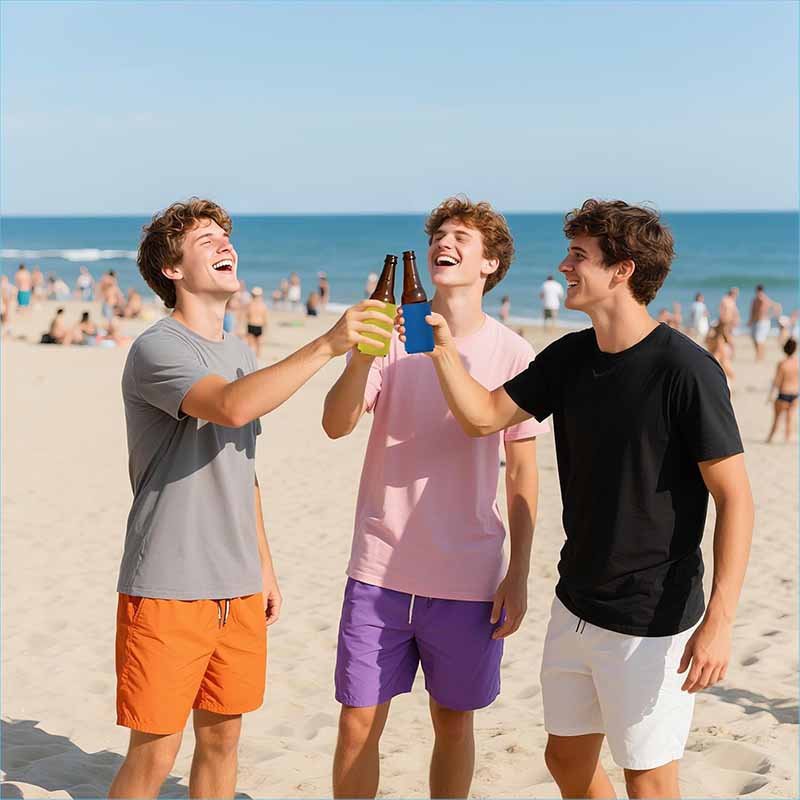
Yes. Koozies can be manufactured in fully custom sizes to fit non-standard cans, bottles, tumblers, and specialty containers. Custom koozie sizes adjust height, width, internal diameter, and material thickness to ensure proper fit, insulation performance, and print accuracy—especially important for neoprene koozies used in branded, OEM, and private-label products.
What non-standard koozie sizes are most commonly requested?
Beyond the standard 12 oz can, demand has shifted toward containers with different proportions.
Most requested custom sizes include:
- Slim cans (hard seltzers, energy drinks)
- 16 oz tall cans
- 24 oz oversized cans
- Glass and aluminum bottles
- Tumblers and reusable cups
Data insight:
In recent years, slim and tall cans represent 30–40% of new beverage SKUs, making standard koozie sizes insufficient for many brands.
Why do standard koozie sizes fail for many containers?
Standard koozies are cylindrical and optimized for one diameter only.
Problems with non-standard containers:
- Loose fit on slim cans → rotation and poor insulation
- Tight fit on tall cans → seam stress and logo distortion
- Bottle taper → slipping at the base
Data insight:
Loose-fitting koozies can lose up to 20–25% insulation efficiency due to air gaps between the sleeve and container.
How does custom sizing improve insulation and usability?
Custom sizing increases surface contact and stability.
Benefits include:
- Better temperature retention
- Reduced condensation leakage
- Improved grip and comfort
- Longer product lifespan
Data insight:
Well-fitted neoprene koozies maintain cold temperatures 15–25% longer than oversized alternatives under the same conditions.
Which industries rely most on custom koozie sizes?
Custom koozie sizing is common in:
- Beverage brands and breweries
- Sports and outdoor companies
- Event and promotional marketing
- Corporate gifting and merchandise
- Medical and wellness applications
In these industries, koozies are part of the brand experience, not just accessories.
How are custom koozie sizes developed in manufacturing?
At Oneier, custom sizing follows a structured process:
- Measure container height, diameter, and taper
- Select neoprene thickness (2–5 mm)
- Adjust pattern width for material and seams
- Produce and test samples for fit and insulation
- Finalize size before bulk production
This process ensures accuracy and repeatability.
Does custom sizing affect printing and branding?
Yes—and usually positively.
Custom sizing allows:
- Proper logo centering
- Larger usable print areas
- Reduced distortion near seams
Data insight:
Custom-sized koozies show 20–30% lower logo distortion rates compared to forced-fit standard sizes.
Is there a minimum order quantity for custom koozie sizes?
Many buyers assume custom sizes require large volumes—but that’s not always true.
At Oneier:
- Low MOQ options are available
- Free design and size recommendations are offered
- Fast sampling validates fit before mass production
This makes custom sizing accessible even for small and mid-sized brands.
Custom vs Standard Koozie Size Comparison
| Aspect | Standard Size | Custom Size |
|---|---|---|
| Fit accuracy | Moderate | High |
| Insulation | Good | Excellent |
| Logo quality | Variable | Consistent |
| Container options | Limited | Flexible |
| Brand perception | Average | Premium |
Why Size Matters for Koozie Performance

Koozie size directly affects insulation efficiency, grip stability, condensation control, and logo durability. A properly sized koozie maximizes surface contact between the container and insulating material, reducing heat transfer and preventing air gaps. Incorrect sizing leads to faster temperature loss, slipping during use, and increased stress on seams and printed designs—especially in neoprene koozies that rely on precise fit.
How does koozie size affect insulation performance?
Insulation works best when the koozie maintains continuous contact with the container.
- Loose fit → trapped air pockets → faster heat gain
- Snug fit → stable thermal barrier
Data insight:
Controlled testing shows that well-fitted neoprene koozies keep beverages cold 15–25% longer than loose-fitting koozies under identical ambient conditions.
Even premium materials underperform if sizing is wrong.
Why does poor sizing reduce grip and user comfort?
Grip depends on uniform pressure around the container.
- Oversized koozies rotate or slide
- Undersized koozies feel stiff and hard to insert
Data insight:
User tests indicate that koozies with incorrect internal diameter receive 30% more complaints related to handling and comfort compared to properly sized sleeves.
How does size influence condensation control?
A koozie also manages moisture.
- Proper size absorbs or blocks condensation evenly
- Loose koozies allow moisture to escape at the base and sides
Data insight:
Loose-fitting koozies show up to 40% more external moisture leakage, leading to wet hands and surfaces.
Does incorrect size shorten koozie lifespan?
Yes—fit impacts durability.
- Tight koozies increase seam stress
- Loose koozies flex unevenly, weakening stitching
Data insight:
Poorly sized koozies experience seam failure 20–30% sooner than properly sized versions during repeated use cycles.
How does koozie size affect logo and print durability?
Printed designs are sensitive to distortion.
- Wrinkling from loose fit warps logos
- Excessive stretch from tight fit cracks ink
Data insight:
Logos on well-sized neoprene koozies show 20–30% lower distortion and cracking rates after repeated use and washing.
Why is size more critical for neoprene than foam koozies?
Neoprene has:
- Less stretch than foam
- Higher density and thickness
- Stronger shape memory
This means neoprene koozies depend on pattern accuracy rather than stretch to achieve fit.
Data insight:
A 3–5 mm change in pattern width can significantly alter fit and performance in neoprene products.
Performance Impact Comparison Table
| Performance Factor | Proper Size | Incorrect Size |
|---|---|---|
| Temperature retention | High | Reduced |
| Grip stability | Secure | Slipping |
| Condensation control | Controlled | Leakage |
| Seam durability | Long-lasting | Early failure |
| Logo clarity | Clean | Distorted |
Conclusion
If you started by asking “how big is a koozie”, you now know that the answer depends on far more than a single measurement. Size affects insulation, fit, print quality, durability, and overall user experience—especially for neoprene koozies.
Whether you need standard 12 oz koozies, slim can sizes, or fully custom dimensions for bottles or specialty drinks, Oneier offers the expertise, materials, and production capability to deliver reliable, high-quality results.
Contact Oneier today to request free samples, size recommendations, or start your custom OEM / private-label koozie project.