
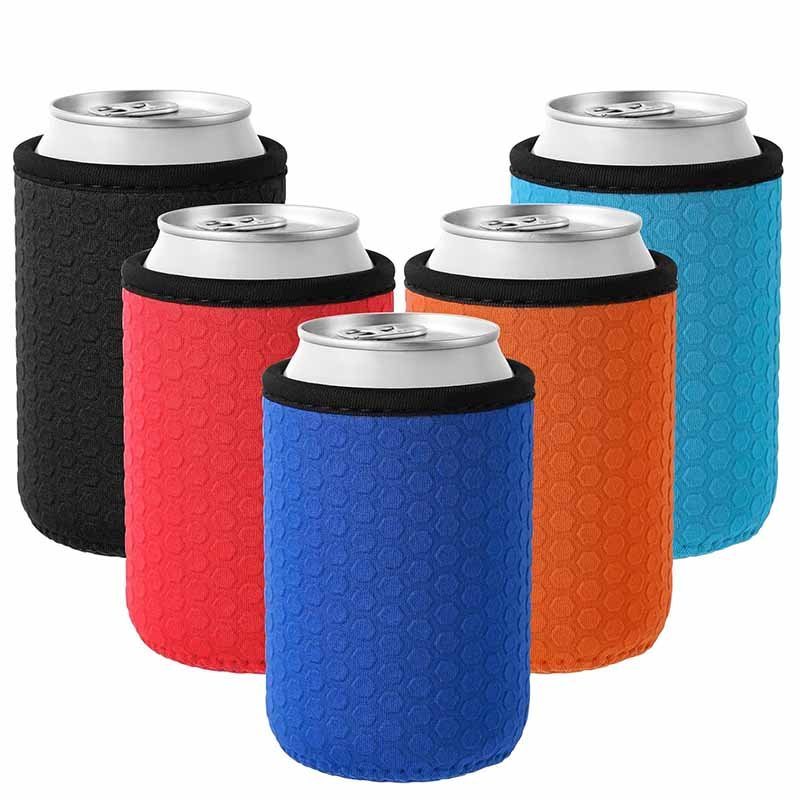
A lot of people assume a neoprene bottle cooler and a neoprene can cooler are basically the same product with a slightly different shape. On the surface, that sounds reasonable. Both are made from neoprene. Both help keep drinks colder. Both reduce hand condensation. Both are widely used for promotions, retail, events, bars, sports, and outdoor activities. But once you start sourcing them for a real business, the gap becomes much more obvious. A bottle cooler that fits poorly can slide, wrinkle, and lose insulation value. A can cooler with the wrong wall thickness can look fine in photos but feel cheap in hand. A design that works for a 330ml can may fail completely for a slim can, glass bottle, beer bottle, or stainless drink container.
A neoprene bottle cooler is made for taller and narrower drink containers such as beer bottles, glass beverage bottles, and some reusable drink bottles. A neoprene can cooler is built for shorter and wider containers such as 330ml or 355ml cans. The main differences are fit, structure, insulation contact, portability, production method, and target market. These details affect product performance, appearance, shipping efficiency, and final cost.
For importers, private label brands, promotional product companies, and beverage accessory sellers, this choice matters more than it seems. The wrong cooler type can create poor user experience, higher complaint rates, and weak repeat orders. The right one can become a strong low-cost product with high reorder potential. That is why it is worth looking at this category more carefully before moving into sampling or mass production.
What Is Neoprene Bottle Cooler vs Can Cooler?
A neoprene bottle cooler and a neoprene can cooler are both insulating drink sleeves made from neoprene, but they are designed for different container sizes and usage habits. The bottle cooler is taller and narrower for bottles, while the can cooler is shorter and wider for cans. The difference is not only in shape. It also affects insulation contact, customization method, packaging style, and market use.
What is neoprene bottle cooler
A neoprene bottle cooler is a soft insulating sleeve developed for drink containers with a long and narrow body. In most cases, this includes beer bottles, glass soda bottles, mineral water bottles, sports drink bottles, and some reusable beverage containers. The main purpose is simple: slow down heat transfer, improve grip, and prevent water droplets from collecting on the outside surface.
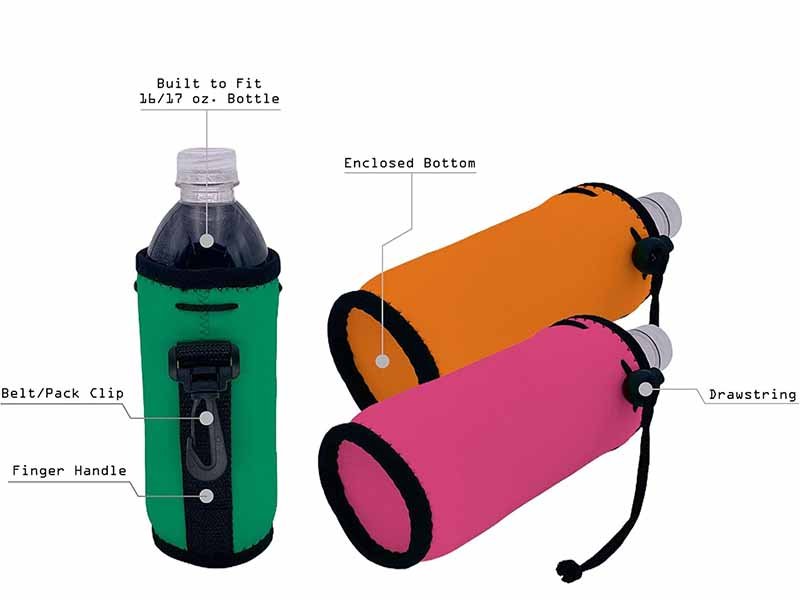
From a product structure point of view, a bottle cooler normally has a vertical cylindrical body, a shaped bottom section, and side seams that allow the neoprene sheet to wrap closely around the bottle. Some versions use glued construction. Others use stitched seams, zigzag overlock, flatlock, or folded-edge sewing, depending on the product grade and price target. Higher-end designs may also include zipper closure, pull tabs, reinforced bottom panels, screen printing, sublimation, embroidered labels, or custom woven tags.
The most common neoprene thicknesses are 3mm and 5mm. A 3mm bottle cooler is lighter, softer, and easier to fold for shipping. A 5mm bottle cooler gives a heavier hand feel and slightly stronger insulation, but it adds bulk and cost. For many custom promotional orders, 3mm is enough. For premium retail drink accessories, 5mm can make the product feel more substantial.
Below is a practical bottle cooler structure guide:
| Item | Common Option | Why It Matters |
|---|---|---|
| Material thickness | 3mm / 5mm | Affects insulation, feel, and cost |
| Body shape | Straight / tapered | Must match bottle profile |
| Bottom type | Glued / stitched | Affects durability and appearance |
| Closure | Open top / zipper | Affects fit and convenience |
| Printing | Screen print / sublimation | Affects logo detail and color range |
What clients often care about most is fit stability. If the bottle cooler is too loose, it loses insulation efficiency and feels cheap in use. If it is too tight, the end user struggles to insert or remove the bottle. A good factory does not just copy a general bottle shape. It adjusts the pattern to the actual container size, wall thickness, and target usage environment.
What is neoprene can cooler
A neoprene can cooler is a sleeve designed for standard beverage cans. It is usually shorter than a bottle cooler and built around the diameter and height of common can formats such as 330ml, 355ml (12oz), and in some cases slim cans or tall cans. Because the can body is more uniform in diameter from top to bottom, the can cooler can achieve a tighter and more predictable fit.
This product is one of the most common neoprene promotional items in the market. It is easy to understand, easy to distribute, and easy to customize with a logo. It is widely used for breweries, beverage brands, wedding events, festival giveaways, sports promotions, tourism souvenirs, corporate events, and retail gift shops. Compared with bottle coolers, can coolers usually have a simpler shape and are easier to standardize for mass production.
Can coolers often come in several common styles:
- collapsible flat can cooler
- stitched base can cooler
- glued base can cooler
- slim can cooler
- tall can cooler
- wrap-style cooler with hook-and-loop closure
The reason can coolers are popular in bulk orders is straightforward. They are compact, cost-effective, and work well for large-volume customization. In many promotional projects, clients want a product that is inexpensive, lightweight, easy to pack, and highly visible with printed branding. Can coolers match that need well.
Here is a basic can cooler comparison:
| Can Cooler Type | Best For | Shipping Efficiency | Visual Appeal |
|---|---|---|---|
| Collapsible flat style | Events, giveaways | High | Good |
| Stitched base style | Retail, premium feel | Medium | Better |
| Slim can style | Energy drinks, sparkling drinks | High | Modern |
| Wrap style | Multi-size use | Very high | Functional |
Another reason can coolers are easier to scale is production repeatability. Because the shape is more regular than bottle sleeves, factories can maintain size consistency more easily. For clients placing repeat orders, that consistency matters in both appearance and user experience.
What is bottle vs can cooler difference
The difference between a bottle cooler and a can cooler is not simply height. It is a combination of container match, insulation contact, manufacturing method, and sales purpose. These products may use the same neoprene sheet, but they are not interchangeable in practical use.
The first difference is container geometry. Bottles are usually taller and narrower, and many have a neck section or curved body. Cans are shorter, straighter, and more uniform in shape. This means bottle coolers often need more precise pattern development, especially when the customer wants a snug fit for a specific beer bottle or drink bottle. Can coolers are easier to standardize because the can body is more consistent.
The second difference is surface contact. A can cooler often touches more of the drink surface evenly, which helps it hold the can more tightly and improve thermal retention. Bottle coolers can still insulate effectively, but depending on the bottle profile, there may be small air gaps or less uniform contact.
The third difference is usage environment. Bottle coolers are commonly associated with outdoor leisure, beach use, picnics, sports, and casual drinking situations where bottled beverages are common. Can coolers dominate bars, parties, events, breweries, branded giveaways, and mass promotions because cans are easier to standardize and distribute.
The fourth difference is production and packing. Can coolers are often easier to fold flat, pack tightly, and ship in bulk. Bottle coolers usually take more space per unit unless the design is made collapsible.
A direct comparison is below:
| Factor | Bottle Cooler | Can Cooler |
|---|---|---|
| Container type | Bottle | Can |
| Product shape | Tall, narrow | Short, wide |
| Pattern complexity | Higher | Lower |
| Surface fit consistency | Medium | High |
| Packing efficiency | Medium | High |
| Main sales channels | Outdoor, lifestyle, gift | Event, promo, beverage branding |
| Unit standardization | Medium | High |
For clients choosing between the two, the key question is not which one is “better” overall. The key question is which one matches the drink format, customer habit, and sales channel more closely.
What clients should focus on before sampling
Before asking a factory for samples, clients should first decide what kind of drink container the product is meant to serve. This sounds basic, but in real business it is one of the most common sources of mistakes. Many projects move into sampling with only a rough idea such as “beer cooler” or “drink sleeve,” without confirming whether the product is for 330ml cans, 355ml cans, slim cans, long-neck beer bottles, short glass bottles, aluminum bottles, or custom beverage packaging.
That missing detail creates downstream problems fast. The pattern is wrong. The printing area changes. The foldability changes. The carton quantity changes. Even the user’s first impression changes. A loose cooler gives a very different feeling from a snug cooler, even if the print quality is identical.
There are several details worth confirming early:
- exact container diameter
- exact container height
- glass, aluminum, or plastic container type
- desired neoprene thickness
- stitched or glued construction
- logo method and print area
- whether the product must fold flat
- whether the product is for retail or giveaway use
This simple planning table helps:
| Decision Point | Why It Matters |
|---|---|
| Container size | Determines pattern and fit |
| Neoprene thickness | Affects insulation, feel, cost |
| Construction method | Affects durability and look |
| Logo method | Affects branding cost and effect |
| Retail or promotion | Affects quality level and packaging |
For example, a low-cost event giveaway may favor a flat collapsible can cooler with screen print. A retail beer accessory line may need a better-finished stitched bottle cooler with edge binding and stronger print quality. A sports drink promotion may need a bottle sleeve with a zipper or carrying feature. The right factory should help clarify these differences before production starts, not after the sample has already been made incorrectly.
How Does Neoprene Bottle Cooler vs Can Cooler Work?
Neoprene bottle coolers and can coolers work by slowing heat transfer between the drink and the outside environment while also reducing condensation on the container surface. Their performance depends on three practical things: neoprene thickness, how closely the cooler fits the drink, and how much of the drink body is covered by the sleeve. A tighter and more accurate fit usually gives better real-use performance than thickness alone.
How bottle cooler works
A neoprene bottle cooler works by wrapping an insulating layer around the main body of a bottle. Neoprene contains a closed-cell foam structure, which means it has many tiny enclosed air pockets inside the material. These air pockets help reduce the speed at which outside heat reaches the drink container. At the same time, the sleeve creates a barrier that helps reduce surface condensation, keeping hands dry and improving grip.
In practical use, bottle coolers are especially helpful when people hold drinks for a longer period outdoors. Think about beach use, backyard gatherings, fishing trips, picnics, sports sidelines, and travel. In those situations, the bottle is repeatedly exposed to warm air and warm hands. The neoprene sleeve slows the temperature change and makes the drink more comfortable to hold.
But bottle cooler performance depends heavily on fit. A loose sleeve may still look acceptable, but the insulation value drops because there is less direct contact with the bottle surface. A badly shaped bottle sleeve can also slide downward or bunch during use, which hurts both function and appearance.
Bottle coolers also vary by coverage. Some stop below the bottle neck. Others extend higher for more coverage. More coverage can help insulation, but it also changes insertion ease and production cost. The best design is usually based on the actual bottle style being used, not on a generic size assumption.
How can cooler works
A neoprene can cooler works on the same basic insulation principle, but it often performs more efficiently because cans have a straighter and more uniform body. This allows the neoprene to wrap more closely and evenly around the drink surface. More contact means less air gap, and less air gap usually means better thermal retention during normal use.
That close fit is one reason can coolers remain so popular in beer, soda, energy drink, and event markets. The product is simple, but it delivers an immediate user benefit. Hands stay drier. The can feels colder longer. The branding stays highly visible while the drink is in hand. For promotional use, that combination is hard to beat at a low unit cost.
Can cooler style also influences performance. A stitched-bottom can cooler usually feels more structured and secure than an ultra-flat collapsible style. A wrap-style cooler can fit multiple can sizes, but it may not feel as tight or polished as a form-fitted style. In custom projects, the right style depends on whether the goal is price, appearance, flexibility, or shipping efficiency.
In many volume orders, clients choose collapsible can coolers because they save space and reduce freight cost. That makes sense commercially. But for better retail feel, a stitched and better-fitted style often gives a stronger user impression.
How insulation works
Insulation in neoprene coolers is influenced by material thickness, material density, fit, coverage, and outside conditions. Thickness matters, but it is only one part of the full result. A thicker sleeve with poor fit may perform worse than a thinner sleeve with a tighter body match.
Here is a practical performance view:
| Factor | Effect on Cooling Performance |
|---|---|
| 3mm neoprene | Good balance of insulation and flexibility |
| 5mm neoprene | Better hand feel and slightly stronger insulation |
| Tight fit | Improves surface contact and heat resistance |
| Loose fit | Reduces insulation efficiency |
| Full-body coverage | Helps retain cooling longer |
| Hot outdoor conditions | Reduces effective cooling time faster |
Many clients assume “thicker is always better,” but that is not always true. A 5mm cooler costs more, ships bulkier, and may feel harder to fold. In some promotional projects, the extra thickness does not create enough value to justify the cost increase. In other projects, especially premium retail items, the thicker material helps the product feel more serious and higher grade.
Another point clients often overlook is condensation control. In real use, many people care as much about dry hands and dry surfaces as they do about actual drink temperature. A well-fitted neoprene cooler reduces water droplets on the outside of the can or bottle, which improves comfort and keeps tables, cars, and bags cleaner.
How fit changes real-world performance
Fit is one of the most underestimated factors in this product category. Two coolers made from the same neoprene, with the same print and same thickness, can perform very differently if one fits properly and the other does not. This is especially important for custom projects, because not every beverage brand uses the same bottle or can dimensions.
A can cooler that is too loose feels low-value the moment someone holds it. The can may shift inside, the print may wrinkle when gripped, and the cooling benefit feels weaker. A bottle cooler that is too tight creates a different problem: it may be difficult to insert, especially if the bottle surface is wet or if the user is trying to use it quickly during an event.
This is why professional sample development matters. The factory should not rely only on a general “12oz can cooler” size unless the product is meant for universal use. If the customer has a specific bottle or can, the pattern should be adjusted to that exact container.
A practical fit guide is below:
| Fit Condition | User Experience | Product Effect |
|---|---|---|
| Too loose | Slides, wrinkles | Weak value feel |
| Too tight | Hard to insert/remove | Poor convenience |
| Correct fit | Stable, easy to use | Better insulation and appearance |
For clients building a serious custom drink accessory line, accurate fit is often the detail that separates a product people keep using from one they forget after the first use.
Which Is Better Neoprene Bottle Cooler vs Can Cooler?
Neoprene bottle cooler vs can cooler is not about which is universally better. It depends on container type, usage environment, and customer expectations. Bottle coolers work better for taller drinks and lifestyle use, while can coolers perform better in tight fit, portability, and large-scale promotional scenarios.
Which fits bottles better
When it comes to bottles, a bottle cooler is always the correct choice. This is not just about height—it is about how the cooler interacts with the shape of the container.
Most bottles have:
- narrower bodies
- curved shoulders
- sometimes a neck section
A can cooler cannot adapt well to these features. If you try to use a can cooler for a bottle:
- the fit becomes loose
- insulation drops
- the product looks unstable
A well-designed bottle cooler solves these problems by matching the bottle profile more closely.
Key fit considerations for bottle coolers:
| Factor | Impact |
|---|---|
| Diameter matching | Prevents slipping |
| Height coverage | Improves insulation |
| Bottom structure | Keeps shape stable |
| Flexibility | Helps fit different bottle shapes |
In real production, bottle coolers often need custom sizing for:
- beer brands
- glass soda bottles
- sports drink bottles
This means slightly higher development work compared to can coolers, but it creates a much better end-user experience.
Which fits cans better
For standard cans, can coolers are clearly the better option. Their structure is designed specifically for cylindrical containers with consistent dimensions.
Standard can sizes:
- 330ml (EU/Asia)
- 355ml / 12oz (US)
- slim cans (energy drinks)
Because these sizes are consistent, can coolers can achieve:
- tighter surface contact
- better insulation
- more stable grip
In practice:
- a properly sized can cooler feels “locked in”
- it does not slide or wrinkle
- branding stays visible and flat
This tight fit is one of the reasons can coolers dominate in promotional markets.
Another key advantage:
- easier to standardize → faster production
- easier to reorder → consistent results
For clients running repeat campaigns or large-volume orders, this consistency is extremely valuable.
Which is better for use
The answer depends on how and where the product will be used.
Here is a practical usage comparison:
| Use Scenario | Better Choice |
|---|---|
| Beer bottle drinking | Bottle cooler |
| Soda / beer cans | Can cooler |
| Outdoor sports | Bottle cooler |
| Events / promotions | Can cooler |
| Travel / beach use | Bottle cooler |
| Bulk giveaways | Can cooler |
From real market data:
- can coolers dominate promotional and event sales (70%+ volume)
- bottle coolers are more common in lifestyle and retail accessory markets
Why this happens:
- can coolers are cheaper and easier to distribute
- bottle coolers feel more personal and functional
So “better” is not about performance alone—it is about how the product fits the business model.
What businesses often misunderstand when choosing
Many clients assume:
- “one cooler can fit all drinks”
- “size difference is minor”
In reality, these assumptions cause problems such as:
- poor fit → bad user feedback
- wrong product type → unsold inventory
- mismatch with target market
A common mistake:
Ordering can coolers for a bottle-focused promotion.
Result:
- customers cannot use the product properly
- brand impression drops
Another mistake:
Over-customizing bottle coolers for a general market.
Result:
- higher cost
- limited usability
The best approach:
- match the cooler type to the main drink format
- keep design simple for broader usability
What Are Neoprene Bottle Cooler vs Can Cooler Pros?
Neoprene bottle coolers and can coolers both offer insulation, branding space, and portability, but their advantages differ based on structure and usage. Bottle coolers provide flexibility and lifestyle appeal, while can coolers offer cost efficiency and mass distribution advantages.
What are bottle cooler pros
Bottle coolers offer several advantages that make them suitable for specific markets.
1. Better for varied drink types
Bottle coolers can handle:
- beer bottles
- water bottles
- sports drinks
This flexibility makes them useful for lifestyle products.
2. Stronger perceived value
Compared to can coolers, bottle sleeves often feel:
- more functional
- more reusable
- less “disposable”
This helps in retail positioning.
3. Better for outdoor use
Bottle coolers are often used in:
- hiking
- beach trips
- cycling
- camping
They are easier to hold for longer periods.
4. More design variation
Bottle coolers can include:
- zippers
- handles
- custom shapes
This allows more product differentiation.
Limitations:
- higher cost than can coolers
- less efficient for bulk distribution
- more size variation required
What are can cooler pros
Can coolers dominate the market for a reason—they are highly efficient products.
1. Lower cost per unit
Can coolers are one of the most cost-effective neoprene products.
Typical pricing:
- large orders: $0.3–$1.0 per unit (depending on design)
2. Easy to mass produce
Because of standardized sizes:
- faster production
- lower defect rate
- easier quality control
3. High branding visibility
Flat surfaces make them ideal for:
- logos
- slogans
- event branding
4. Easy to ship and store
Collapsible designs allow:
- high packing density
- lower shipping cost
Limitations:
- limited to can shapes
- lower perceived value in some markets
- less product differentiation
What are cooler limits
Both bottle and can coolers have limitations that should be understood before product development.
Bottle cooler limitations:
- not universal → must match bottle size
- higher cost per unit
- bulkier for shipping
Can cooler limitations:
- limited to standard can sizes
- less flexible for different drink types
- may feel low-end if poorly made
Here is a direct comparison:
| Category | Bottle Cooler | Can Cooler |
|---|---|---|
| Flexibility | High | Low |
| Cost | Medium | Low |
| Customization | High | Medium |
| Shipping efficiency | Medium | High |
| Market type | Lifestyle / retail | Promotion / events |
How to balance pros and cons in real projects
In real production, many successful clients do not choose one or the other—they use both.
Examples:
- bottle coolers for retail sales
- can coolers for marketing campaigns
Or:
- standard can cooler + premium bottle cooler version
This allows:
- broader market coverage
- different pricing levels
- better brand positioning
A smart product strategy often includes:
- entry-level product (can cooler)
- mid-level product (better can cooler or hybrid)
- premium product (bottle cooler or custom design)
How to Choose Neoprene Bottle Cooler vs Can Cooler?
Choosing between neoprene bottle cooler vs can cooler is about matching the product to the drink type, sales channel, and price strategy. The right choice depends on how the product will be used, how it will be sold, and what level of quality your market expects.
How to choose cooler type
The most effective way to choose between bottle and can coolers is to start from real usage, not just product appearance.
There are three key decision steps:
1. Identify the main drink format
Ask:
- Is the product for bottles or cans?
- Are the containers standard size or customized?
If your product targets:
- beer bottles → choose bottle cooler
- soda or beer cans → choose can cooler
Trying to use one type for both usually leads to poor fit and lower user satisfaction.
2. Define the use environment
Different environments require different cooler types:
| Use Environment | Recommended Cooler |
|---|---|
| Outdoor / sports | Bottle cooler |
| Bar / party | Can cooler |
| Promotional events | Can cooler |
| Travel / lifestyle | Bottle cooler |
Bottle coolers are better for longer holding time and mobility.
Can coolers are better for short-term use and large distribution.
3. Define your price target
Price positioning strongly affects your choice:
| Price Level | Best Option |
|---|---|
| Low-cost giveaway | Can cooler |
| Mid-range product | Upgraded can cooler |
| Premium product | Bottle cooler |
A common mistake is using bottle coolers in low-cost campaigns, which increases cost without improving conversion.
A simple decision guide:
| Priority | Best Choice |
|---|---|
| Lowest cost | Can cooler |
| Best fit for bottles | Bottle cooler |
| High-volume distribution | Can cooler |
| Lifestyle branding | Bottle cooler |
| Balanced strategy | Both |
Which cooler fits your market
Different markets respond differently to bottle and can coolers. Understanding your target customers helps you avoid overdesigning or underperforming.
Promotional products market
- Focus on cost and volume
- Short usage cycle
- Branding visibility is key
Best choice:
- Can cooler (collapsible type)
Retail and gift market
- Focus on product quality and usability
- Customers expect better design
Best choice:
- Bottle cooler or premium can cooler
Beverage brand marketing
- Focus on brand exposure
- Large-scale distribution
Best choice:
- Can cooler (standard size, strong print)
Outdoor / sports market
- Focus on function and durability
Best choice:
- Bottle cooler
Here is a quick market fit table:
| Market Type | Recommended Product |
|---|---|
| Events / giveaways | Can cooler |
| Retail stores | Bottle cooler |
| Beer branding | Both |
| Outdoor lifestyle | Bottle cooler |
| E-commerce | Hybrid strategy |
Choosing the wrong product for your market often results in:
- low usage rate
- weak repeat orders
- poor customer feedback
How to customize cooler
Customization is one of the biggest advantages of neoprene products, and it directly affects how your product stands out.
Key customization options include:
1. Material thickness
- 3mm → flexible, lower cost
- 5mm → thicker, more premium feel
2. Printing methods
| Method | Best For |
|---|---|
| Screen printing | Simple logos, low cost |
| Sublimation | Full-color designs |
| Heat transfer | Detailed graphics |
3. Structure options
- stitched seams → stronger, better finish
- glued seams → lower cost
- zipper closure → better fit for bottles
4. Additional features
- handles
- straps
- custom shapes
- reinforced bottom
A practical customization strategy:
- keep base design simple
- focus on logo and color
- upgrade structure only when needed
This helps control cost while maintaining strong product appeal.
How manufacturers support your decision
A strong factory plays a key role in helping you avoid mistakes before production starts.
Experienced manufacturers like Oneier support clients in several ways:
1. Product recommendation
Based on your:
- target market
- budget
- usage scenario
They suggest:
- bottle vs can cooler
- material thickness
- structure type
2. Sample development
Factories provide samples to test:
- fit accuracy
- insulation performance
- printing quality
This helps you compare options before bulk production.
3. Cost optimization
Instead of reducing quality blindly, they help:
- simplify design
- optimize material usage
- improve production efficiency
This can reduce cost by 10%–20% without affecting performance.
4. Production control
Reliable factories ensure:
- consistent material quality
- stable production output
- proper quality checks
This reduces:
- defects
- delays
- unexpected costs
Work With Oneier to Build Your Custom Cooler Line
If you are planning to develop neoprene bottle coolers or can coolers, the biggest advantage is working with a factory that understands both materials and real market needs.
Oneier has over 18 years of experience in neoprene material development and product manufacturing, supporting global brands with custom solutions.
Start your custom project
To get started, simply send:
- your design or idea
- target quantity
- preferred material or budget
Oneier will help you:
- choose the right cooler type
- develop accurate samples
- deliver production-ready products
Contact Oneier today and turn your cooler idea into a reliable, market-ready product.